
When the employee who manages a company's WLKP account resigns, access to years of mandatory manpower reporting can disappear overnight. WLKP account recovery in Indonesia may involve restoring access to company records, not just resetting a password.
In this blog, we discuss WLKP account recovery in Indonesia. We explain the difference between an individual SIAPkerja login and the company record. We cover cooperative transfers and enquiries when the administrator is unreachable. We also suggest checks for head offices, branches and reporting history.
What Does WLKP Account Recovery in Indonesia Actually Involve?
Recovery means restoring an authorised person's access to the company's existing WLKP record — it does not mean taking over a departing employee's personal login.
WLKP stands for Wajib Lapor Ketenagakerjaan Perusahaan, the mandatory company manpower report. Under Law No. 7 of 1981, employers or managers must report within 30 days after establishment, reactivation or relocation, and at least 30 days before relocation, suspension or dissolution; periodic reporting is also required each December. For the first reporting period, the NIB obtained through OSS can serve as evidence of WLKP compliance; subsequent reports are submitted online through Kemnaker's WLKP system using the authorised manager's account.
The distinction that decides the route is this: a login problem and a company-record problem are different failures. A forgotten password affects one individual account. A resignation affects the company record, because the person holding authority over it has left. Our professional judgement — an interpretation rather than a confirmed platform rule — is that a password reset never transfers company authority by itself.
The stakes are real. WLKP reporting sits inside the broader corporate compliance requirement in Indonesia, alongside tax, social security, and investment filings. An inaccessible record can delay statutory reporting and complicate a labour inspection, so the recovery route should restore the existing record rather than work around it.
Kemnaker's Pasker help centre publishes the operating guidance for these systems, and it is the primary official source for the transfer and recovery steps below.
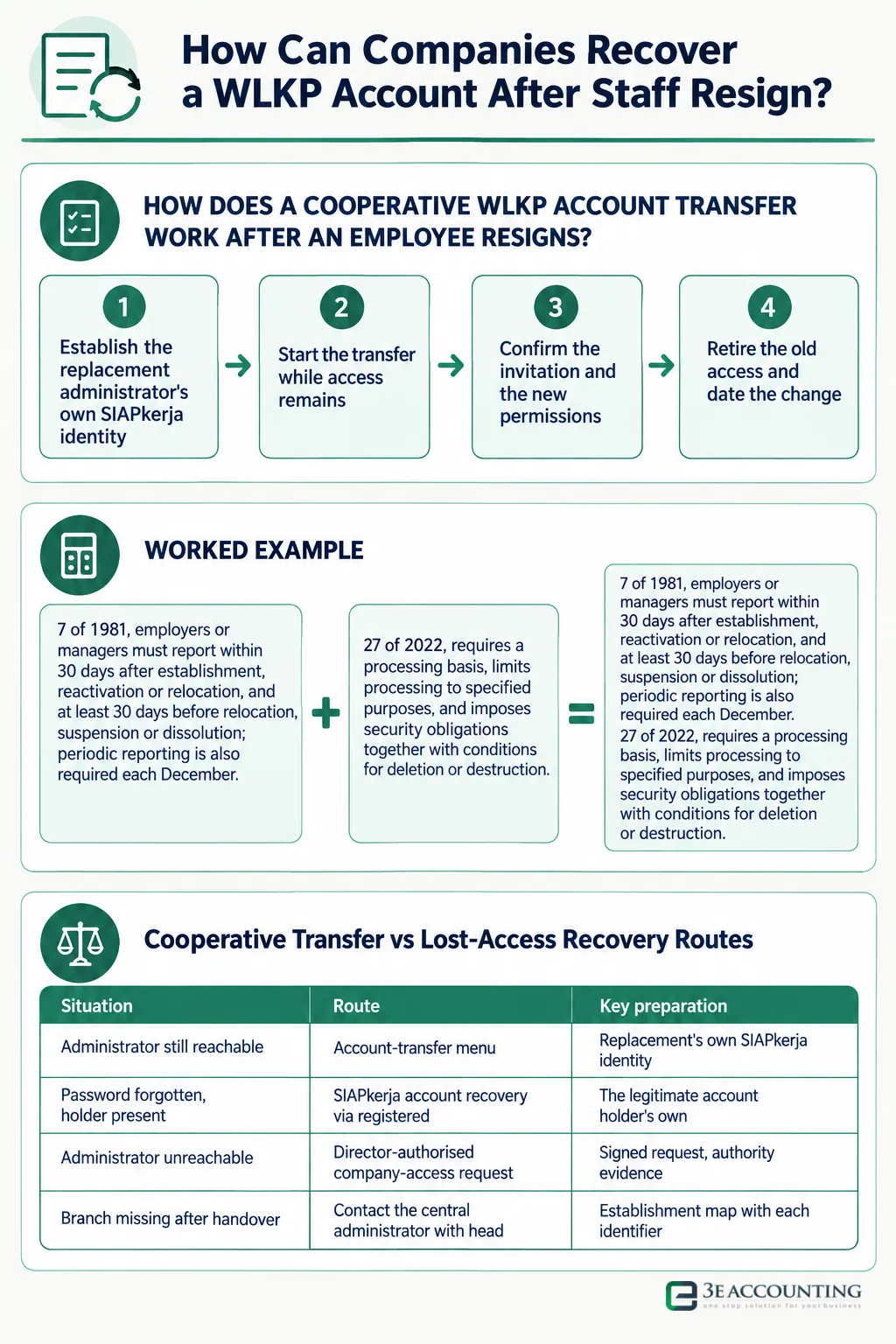
How Does a Cooperative WLKP Account Transfer Work After an Employee Resigns?
When the outgoing administrator can still log in, Kemnaker describes a transfer flow in which the current manager enters the new manager's email and sends an invitation.
Start the handover while the departing employee can still access the account. Their access may end before or continue after their last working day. Kemnaker describes a transfer menu in the account-management section. The current manager enters the replacement's email and sends an invitation. Confirm how the replacement completes the transfer. This is published operational guidance, not a verified statutory requirement. It does not prove that every transfer preserves each branch and historical report. Confirm the current screen and completion steps before relying on it.
Invitations sometimes fail to arrive. Kemnaker's advice for that situation is to check that the email address is registered with SIAPkerja and to request a resend through the WLKP complaints channel. That guidance addresses an undelivered invitation only. It does not set out what to do when the former manager is no longer available at all.
Our team's recommendation is not to ask a departing employee for their personal SIAPkerja identity or password. The handover should move company-level permissions onto the replacement's own account, so the company never again depends on one personal credential.
Step 1: Establish the replacement administrator's own SIAPkerja identity
The incoming person-in-charge first needs their own valid account, tied to an email address or phone number the company can verify. Without their own identity, there is nothing for the platform to invite or authorise.
Step 2: Start the transfer while access remains
The cooperative route closes when the outgoing administrator loses access. Where an HR or finance officer has resigned, start the transfer early, while they can still authenticate and confirm which records they administer.
Step 3: Confirm the invitation and the new permissions
The replacement should accept the invitation, log in independently, and open the company record. If the invitation does not arrive, check the email registration first and request a resend through the official complaints channel.
Step 4: Retire the old access and date the change
Where the platform or the support team can verify it, confirm that the former employee no longer holds company permissions. Keep a dated internal note of who authorised the change and when.
Cooperative Transfer vs Lost-Access Recovery Routes
| Situation | Route | Key preparation | Main caution |
|---|---|---|---|
| Administrator still reachable | Account-transfer menu: current manager invites the new manager's registered email | Replacement's own SIAPkerja identity, verified before the last working day | Transfer guidance is operational, not statutory — confirm current steps |
| Password forgotten, holder present | SIAPkerja account recovery via registered phone, email, or identity verification | The legitimate account holder's own registered details | Recovers the individual login; it does not transfer company permissions |
| Administrator unreachable | Director-authorised company-access request through Kemnaker's support channel | Signed request, authority evidence, NIB and WLKP identifiers, administrator details | Our recommended route — receiving channel and requirements must be confirmed first |
| Branch missing after handover | Contact the central administrator with head office and branch registration codes | Establishment map with each identifier and latest receipt | Do not re-register the branch to make it appear |
What Should a Company Do When WLKP Credentials Are Lost?
The account holder can use SIAPkerja recovery; if the administrator is unavailable, the company can enquire with Kemnaker about authorised access.
Where a password is simply forgotten, SIAPkerja provides account recovery through a registered phone number, an email address, or identity verification. That route is individual account recovery. It does not by itself transfer a former employee's permissions over the company record, and the legitimate account holder should use it for their own account.
Where the administrator is unreachable, our team recommends a director-authorised enquiry about company access. Kemnaker's employment-application helpdesk is a possible starting point. This is reasoned professional judgement, not a confirmed procedure. The helpdesk is a reasonable enquiry starting point rather than a verified receiving channel, so obtain a dated official response on the responsible unit, the procedure, and the requirements before relying on it.
Two cautions apply in the meantime. Stop repeated password attempts, because they risk a lockout that creates a separate technical problem. As a precaution, seek clarification about the existing record before creating another registration.
The document pack we propose for such a request is a working checklist, not a verified mandatory attachment list. Confirm the actual requirements and secure submission arrangements with the receiving office.
1. A director-signed request letter
The letter identifies the company, its NIB and WLKP registration number, the former administrator who has ceased their assignment, and the replacement who will hold access. It asks that the existing registration, establishment relationships, and reporting history be preserved, and it avoids authorising disclosure of any personal password. This is a hypothetical sample, not an official form or a letter used by 3E. Obtain practitioner approval and confirm the wording and signatory with the receiving office.
2. Evidence of the signatory's authority
A corporate deed, approval evidence, or notification evidence showing that the signing director may bind the company. This is our proposed item, not a verified attachment, so confirm what the receiving office actually requires.
3. NIB and WLKP registration identifiers
The company registration number and the WLKP registration number, together with the latest reporting receipt. For companies still assembling these identifiers, our guide on how to obtain a company registration number (NIB) in Indonesia explains where the number comes from.
4. Outgoing and incoming administrator details
Names, positions, account identifiers, and contact details for both persons, so that support can verify who held access and who will hold it.
5. Adviser authorisation where a provider submits the request
If a Corporate Services Provider coordinates the request, a signed authorisation could identify the firm and its proposed authority. Confirm whether the receiving office requires it. Provide identity documents only through a secure channel and only where the receiving office asks for them.
Proposed Document Pack for a WLKP Access Recovery Request
| Document | Purpose | Status |
|---|---|---|
| Director-signed request letter | Identifies the company, the former administrator, and the replacement, and asks to preserve the existing record | Hypothetical sample wording — confirm acceptable phrasing with the receiving office |
| Evidence of signatory authority | Shows the signer may bind the company | Proposed item — confirm with the receiving office |
| NIB | Identifies the registered business | Standard company identifier |
| WLKP registration number and latest receipt | Locates the existing reporting record | Proposed item — confirm with the receiving office |
| Outgoing and incoming administrator details | Lets support verify who held access and who will hold it | Proposed item — include account identifiers |
| Adviser authorisation letter | Allows a Corporate Services Provider to coordinate the request | Only where an external provider submits on the company's behalf |
How Do You Keep Branch Access and Reporting History Intact?
For a missing branch, Kemnaker's guidance is to contact the central administrator with the head office and branch registration codes — which makes an establishment map the natural first step.
A company with a head office and branches may hold several WLKP registration records or establishment relationships. Our working assumption, to be verified case by case, is that not every branch is a separate login and that not every establishment under one administrator shares a single reporting record. The relationships that actually exist in the platform determine what the recovery request must cover.
That is why the establishment map comes first. List each location with its name, address, WLKP registration identifier, latest receipt, and current account visibility, and save the available receipts and report copies before any change. Include the map in any support request, so that head office access is not restored while the branches stay locked.
Where a branch is missing after a handover, Kemnaker's guidance is to contact the central administrator with the head office and branch registration codes. That is guidance for a missing branch. It is not confirmation that a transfer automatically preserves branch access or reporting history.
Our precautionary recommendation is to escalate the missing link rather than re-register the same establishment merely to make it appear on a new dashboard. A fresh registration can fragment the evidence trail instead of recovering it.
1. Map every establishment before any change
Record each location's identifier, address, latest receipt, and current visibility. The map drives both the support request and the post-transfer reconciliation.
2. Request restoration against each existing record
Ask for access to the records as they exist rather than a recreation. Ambiguous requests risk resolving the head office while the branches remain inaccessible.
3. Reconcile identifiers after the transfer
Compare the NIB, WLKP identifiers, locations, and available historical reporting periods against the pre-transfer evidence. Investigate any difference before sign-off.
4. Escalate missing branches rather than re-registering
Follow the central-administrator route with the registration codes when a branch disappears from the dashboard. Confirm the appropriate route for the specific record with Kemnaker before creating anything new.
Handover Verification Checklist After a WLKP Transfer
| Check | What it proves | Evidence to keep |
|---|---|---|
| Independent login by the replacement | The new administrator holds live, own-credential access | Dated access checklist |
| Record and identifier match | The correct company and establishment records are open | Redacted screenshots |
| Historical report or receipt retrieval | Reporting history survived the change | Reporting receipts and copies |
| Former administrator's access retired | Company permissions no longer sit with the ex-employee | Support response or platform confirmation |
How Do You Verify the WLKP Recovery Worked Before Sign-Off?
A password reset alone is not evidence of a completed handover. Proposed checks include an independent login and inspection of the correct records.
Our team's proposed checks are a control, not a verified platform procedure or an approved 3E sign-off. The replacement logs in with their own credentials, completes any required authentication, and opens the correct company and establishment records. Compare the NIB, WLKP identifiers, addresses, reporting status and available history with the pre-transfer evidence. Where the platform or support team can verify it, check that the former employee no longer has company access.
The testing is non-destructive. Inspect the reporting screens and retrieve an existing report or receipt. Never submit a dummy statutory report to prove access. If a genuine report is due, complete it only after the authorised company representative approves the data, then retain the resulting acknowledgement.
A proposed handover pack could contain the support response and a dated access-and-establishment checklist. It could also include redacted screenshots and relevant reporting receipts. It never contains passwords or authentication codes. This is a proposed evidence pack, not an official proof-of-transfer requirement, so confirm what evidence the platform and support team actually provide.
Where internal capacity is thin, a Corporate Services Provider can run the verification and assemble the pack — reach our team through our contact page.
1. Independent login by the replacement
The incoming administrator authenticates with their own credentials and opens the company record unaided. A shared screen does not establish independent access.
2. Identifier and history reconciliation
Match the NIB, WLKP identifiers, addresses, and reporting status against the pre-transfer map, and open an available historical report where the platform exposes one.
3. Retrieval of an existing report or receipt
Downloading an existing acknowledgement proves live access to the record without creating a new statutory submission.
4. Confirmation the former administrator's access is retired
Where the platform or support team can verify removal, record it. Where they cannot, note the limitation in the handover file.
Common WLKP Access Failures and First Responses
| Symptom | Likely cause | First response |
|---|---|---|
| Transfer invitation never arrives | Possible causes include an unregistered SIAPkerja email or an expired invitation | Check the registration, then request a resend through the WLKP complaints channel. |
| Lockout after repeated attempts | Failed login attempts | Stop attempts, preserve the error and timestamp, follow on-screen recovery or raise a support request |
| Branch absent from the dashboard | Establishment link not visible to the new administrator | Contact the central administrator with the head office and branch codes |
| Company email unregistered | Access sits with a named manager’s own SIAPkerja account, usually under a different email | Establish which SIAPkerja identity holds authority before creating any new mailbox |
What Data Protection and Record-Keeping Rules Apply?
Indonesia's Personal Data Protection Law requires a processing basis and sets conditions for security and deletion — so the handover itself needs a lawful basis and controlled records.
Indonesia's Personal Data Protection Law, Law No. 27 of 2022, requires a processing basis, limits processing to specified purposes, and imposes security obligations together with conditions for deletion or destruction. Application depends on the data, the processing basis, and the circumstances. Obtain legal review of the handover process, retention arrangements, and any cross-border transfers, and do not treat deletion as unconditional.
WLKP records carry worker-level personal data. Handle identity documents through secure channels only, redact screenshots before filing them, and restrict access to the handover file. A former employee's data should be processed only where a lawful basis exists.
Our team proposes retaining the submitted report or available copy and its receipt or acknowledgement. The proposed file could also include registration identifiers, reporting dates and status, supporting employee-data snapshots, and internal approvals. It could hold correspondence about corrections or access changes, organised by establishment and reporting period. This is a proposed approach, not an established 3E retention practice. The recovery request and its closure confirmation belong in the same file, so a future administrator can explain why access changed. Set retention periods under a legally reviewed internal schedule rather than informal practice.
Handovers of this kind are among the reasons companies move statutory reporting to an external team. Our accounting outsourcing article sets out what a provider takes over and what stays with the company.
Conclusion
WLKP account recovery in Indonesia comes down to a few disciplines. Separate the personal login from the company record. Transfer while the administrator is reachable, or enquire about company access if they are not. Verify access independently. Seek clarification before registering the company again.
3E Accounting Indonesia is a Corporate Services Provider that supports companies in Indonesia with incorporation, corporate secretarial, accounting, tax, and business advisory services. Our team can help plan a WLKP handover and prepare an enquiry when access has been lost. The responsible authority must confirm the procedure and requirements.
If your company can no longer reach its WLKP record, our team can assess the situation, prepare the request, and manage the verification for you.
Regain Control of Your WLKP Reporting
Speak with 3E Accounting Indonesia about restoring authorised access to your company's WLKP record and keeping statutory manpower reporting on schedule.
Frequently Asked Questions
Only the legitimate account holder should use SIAPkerja's password-recovery options, which rely on a registered phone number, an email address, or identity verification. A reset restores that individual's login. It does not transfer authority over the company's WLKP record. If the administrator is unavailable, the company can enquire with Kemnaker about the appropriate access route.
Kemnaker's guidance is to check that the new manager's email is registered with SIAPkerja and to request a resend through the WLKP complaints channel. Note that this guidance covers undelivered invitations. It does not set out what to do when the former administrator is unavailable.
Not without first checking the appropriate route. A duplicate registration could fragment the reporting history and evidence trail. Our recommendation — a precaution rather than a prohibition — is to seek clarification about the existing record first, escalating to the central administrator or Kemnaker support where branch links are missing.
We are not aware of a verified nationwide attachment list for this scenario as of November 2026. Our proposed pack is a director-signed request, evidence of the signatory's authority, the NIB and WLKP registration identifiers with the latest receipt, details of both administrators, and an adviser authorisation where a provider submits on the company's behalf. Confirm the actual requirements with the receiving office.
Have the replacement administrator log in independently and open the correct company and establishment records, then reconcile identifiers and available history against pre-transfer evidence. Retrieving an existing report or receipt checks access to that item without a dummy submission. It does not establish that all history is available. Record the support response, and keep passwords and authentication codes out of the handover file.

Abigail Yu
Director
Abigail Yu oversees executive leadership at 3E Accounting Group, leading operations, IT solutions, public relations, and digital marketing to drive business success. She holds an honors degree in Communication and New Media from the National University of Singapore and is highly skilled in crisis management, financial communication, and corporate communications.