
A missing joiner can offset a stale leaver, hiding branch errors in a matching company-wide payroll total. In Indonesia, WLKP headcount reconciliation compares HR, payroll and both BPJS schemes by location across provinces, supporting verification without proving every establishment reported correctly.
In this article, we discuss WLKP headcount reconciliation for employers in Indonesia with a head office and multiple branches. We cover legal scope, an employee-level worksheet, staff movements and escalation routes.
What Is WLKP and Which Locations Must Report?
WLKP (Wajib Lapor Ketenagakerjaan di Perusahaan) is Indonesia's mandatory manpower reporting regime, and the obligation extends to qualifying branch offices as well as the head office.
Mandatory Company Manpower Reporting (Wajib Lapor Ketenagakerjaan di Perusahaan, or WLKP) is governed by Law No. 7 of 1981. It is implemented through Minister of Manpower Regulation No. 18 of 2017, as amended. Employers submit employment data through the Ministry of Manpower's WLKP system, which records each reporting company and its workforce details.
The recurring obligation is annual, with separate event-based reports for specified company events such as commencing operations. The applicable filing month and current operational procedure are set by the prevailing regulation. Employers should confirm both against the Ministry of Manpower's current guidance before each cycle.
Crucially for multi-site groups, Article 4(2) of Law No. 7 of 1981 extends the reporting obligation. It covers qualifying branch offices or independently standing parts of a company. A head office submission therefore does not automatically discharge every location's obligations. The correct treatment of a particular branch depends on the company's legal and establishment structure. It should be verified with the relevant manpower authority rather than assumed.
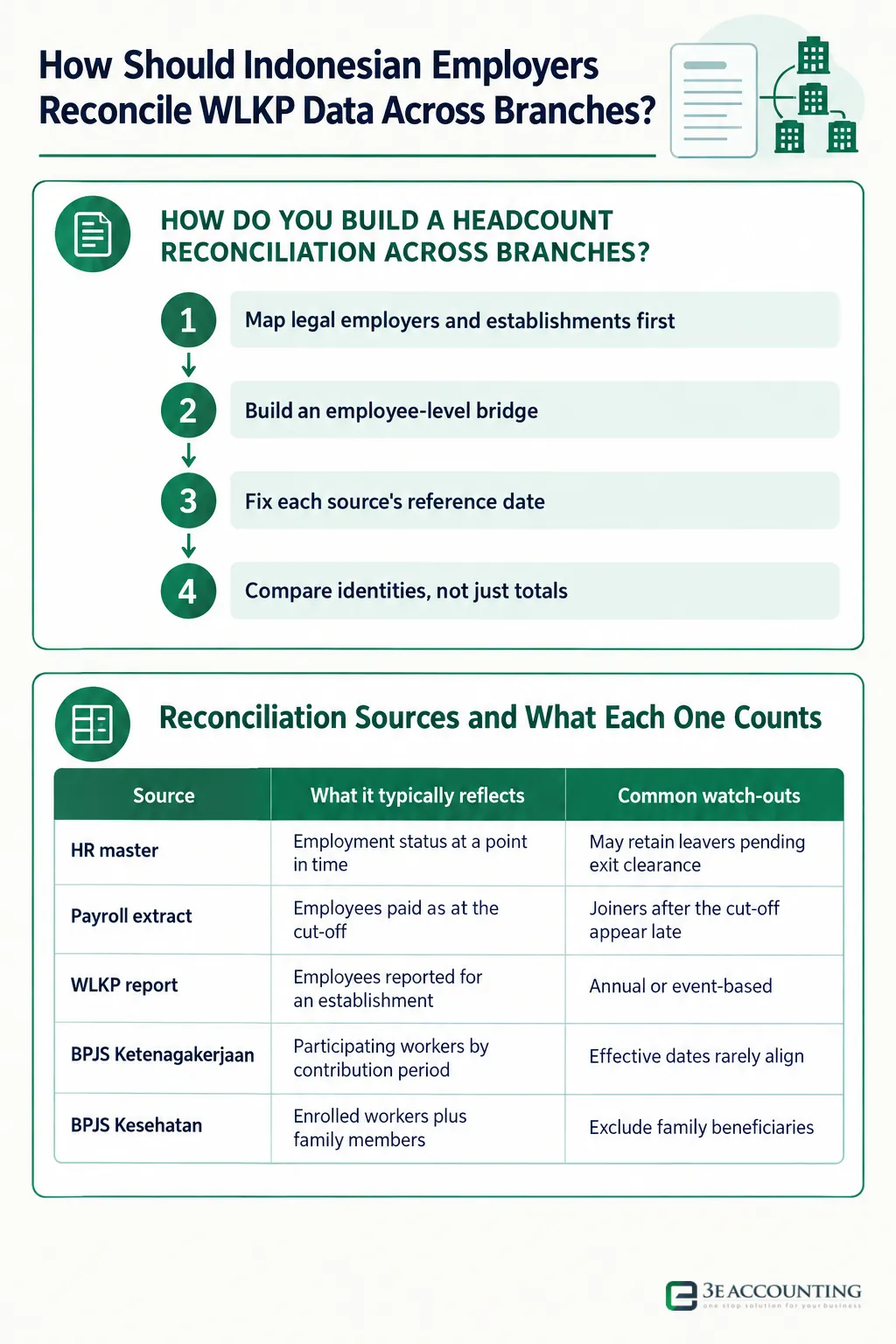
How Do You Build a Headcount Reconciliation Across Branches?
Map the legal employers and establishments first, then build an employee-level bridge, fix each source's reference date, and compare identities as well as totals.
A location-and-month summary is useful, but it is only as reliable as the employee-level detail underneath it. The team's recommended sequence treats the reconciliation as a control in its own right. It is separate from the statutory filings it supports. For WLKP headcount reconciliation in Indonesia, the 3E Accounting Indonesia team recommends comparing employee identities by location. The four steps below outline that proposed approach.
1. Map legal employers and establishments first
Start with the legal employer and establishment map, not the payroll chart. A subsidiary is a separate legal person; a branch without separate legal personality remains part of its employing company. Verify incorporation documents, company registration number (NIB) details, workplace addresses and existing WLKP establishment records together. Do this before comparing a single headcount. Where the current WLKP structure does not clearly represent the operating establishments, resolve that question. Do so with the relevant manpower office first.
2. Build an employee-level bridge
Underneath any location summary, keep one worksheet with a row per employee. Add columns for HR status, payroll status, the WLKP record and both BPJS schemes. Count people, not payslips or contribution lines. Every WLKP figure should be transcribed from saved report evidence. Use the submitted report and its acknowledgement, so an old annual figure is never mistaken for current-period data. Even companies that outsource bookkeeping and payroll should own this reconciliation; the worksheet is a management control, not a filing.
3. Fix each source's reference date
Each source speaks as of a different date. The payroll extract reflects a processing cut-off. BPJS extracts reflect contribution periods and participation effective dates. The WLKP figure carries its own reporting date. Record the actual reference date beside every column, and distinguish an explained timing difference from a genuine error. Teams spread across different Indonesia time zones should agree the cut-off in writing. Every branch then freezes data at the same moment.
4. Compare identities, not just totals
A company-wide total can match perfectly while two branches are equally and oppositely wrong. A missing joiner cancels a stale leaver. A WLKP headcount reconciliation that stops at totals proves nothing about branch-level allocation. List every employee whose location differs between sources, and resolve each one individually.
Reconciliation Sources and What Each One Counts
| Source | What it typically reflects | Common watch-outs |
|---|---|---|
| HR master | Employment status at a point in time | May retain leavers pending exit clearance |
| Payroll extract | Employees paid as at the cut-off | Joiners after the cut-off appear late; leavers with final payments linger |
| WLKP report | Employees reported for an establishment | Annual or event-based; always check its actual reporting date |
| BPJS Ketenagakerjaan | Participating workers by contribution period | Effective dates rarely align with the payroll cut-off |
| BPJS Kesehatan | Enrolled workers plus family members | Exclude family beneficiaries for an employee-count comparison |
Why Do BPJS and WLKP Headcounts Often Disagree?
Differences can arise from definitions or timing, including dependants, foreign workers, agency staff and central BPJS registration.
BPJS Kesehatan's participant records distinguish employed workers from their enrolled family members. For an employee headcount comparison, exclude family beneficiaries from the BPJS Kesehatan employee-participant count. This is a comparison definition, not a claim that dependants lack coverage. Confirm the extract's field and status definitions before relying on it.
BPJS Ketenagakerjaan's contribution records reflect participation by contribution period and effective date, which rarely aligns exactly with a payroll cut-off. Foreign employees should be tracked in supporting columns: differing insurance arrangements do not remove a worker from the employment roster. Agency staff and employees on extended leave should be identified separately. A reconciliation exclusion is not a legal exemption from any reporting obligation.
Where BPJS participation is held under one central employer account, any branch-level split is an internal allocation. It is drawn from the employee-level bridge, not an official BPJS branch breakdown. Confirm the employer's actual registration structure and extract fields before using such an allocation in a review.
How Should Transfers Between Branches Be Treated?
In a point-in-time reconciliation, a transferred employee belongs at one branch only — the location of documented, effective workplace assignment on the reference date.
Three things must be kept apart: employment location, payroll charging and insurance administration. A payroll cost-centre change is not necessarily a workplace transfer. Finance teams often defer cost-centre updates into the following month. A central BPJS account may not show inter-branch movements. It cannot by itself establish where an employee works.
Compare the signed transfer letter with confirmation of actual deployment. Together, they can help establish the workplace at the reference date. An employee should never be counted at both branches for the same reference date. Do not double-count just because both locations incurred salary costs during the month.
Two cautions apply. First, confirm the location basis used in the relevant WLKP record before amending anything. A payroll cost centre or central BPJS account may not establish workplace location. Second, a transfer between separate legal entities is a different matter entirely. It involves a change of employer and corresponding participation documentation, not a simple internal cost-centre move.
Evidence That Settles Each Movement
| Movement | Primary evidence | What it settles |
|---|---|---|
| Branch transfer | Signed transfer letter and deployment confirmation | Effective workplace at the reference date — one branch only |
| New joiner | Employment agreement, commencement and attendance records | Active status despite the payroll cut-off |
| Leaver | Resignation acceptance with the final employment date, plus exit clearance | Exclusion from the active roster |
| BPJS mismatch | Participation status and effective-date records from the scheme | Insurance position, separate from employment status |
How Do Joiners and Leavers Create Timing Differences?
Joiners and leavers create timing differences across payroll, BPJS and WLKP records.
- A joiner after the payroll cut-off can offset a leaver awaiting final pay.
- Identity-level checks beat totals.
Movements expose every mismatch between the payroll cut-off, BPJS effective dates and the WLKP working list. Each type of movement has a document that settles it. Each should be checked against the insurance record separately from the payroll record.
1. Prove the joiner with commencement evidence
A signed employment agreement, a confirmed commencement date and an attendance record establish active status. They do so even where the payroll extract was frozen before the start date. Verify the BPJS participation effective dates separately — an application receipt alone does not prove coverage has already taken effect.
2. Fix the leaver's true last day
The document that matters is the resignation acceptance recording the agreed final employment date, supported by exit clearance. A final payroll payment does not by itself establish the employment end date or prove that all amounts owed have been settled. Neither the last attendance date nor a payslip should be mistaken for the legal employment end date.
3. Check BPJS status independently
Month-end participation extracts may drop a leaver before payroll finishes the final payment. They may also show a joiner before HR updates its working list. Compare the employment record and the participation record side by side. Investigate any case where the two still disagree after the documents above are applied.
Where to Route Each Type of Discrepancy
| Issue | Recommended route |
|---|---|
| Missing HR or payroll documents | Client HR and payroll teams, within a defined response window |
| Disputed BPJS participation date or status | The relevant BPJS scheme's service channel or office |
| WLKP establishment or accepted-report question | The relevant regional manpower office (Disnaker) |
| System-level WLKP access or function issue | Ministry of Manpower support |
| Historical accepted report | Written correction request with original acknowledgements attached |
When Should You Escalate a Headcount Discrepancy?
Escalate by issue type and by risk, not by size alone — anything touching employment rights, insurance protection or an active inspection goes up immediately.
Escalation thresholds are useful internal controls, but they are internal choices, not statutory limits; a smaller or newer discrepancy is not automatically harmless. Give the responsible internal teams a defined window to produce source documents, then route whatever remains by issue type — and never ask one agency to certify another agency's records.
Before any correction, preserve the original submissions and acknowledgements. Where an already-accepted historical report is in question, request the correction route in writing rather than assuming a current-data edit rewrites a past submission. A portal edit or authority correspondence does not automatically cure late reporting, remove potential sanctions or clear an inspection. Seek case-specific legal and authority confirmation where relevant.
Keeping the wider statutory record set in order — minutes, licences and registrations — is where corporate secretarial support complements the payroll file. Groups without a dedicated compliance function can also contact our team to structure the workflow end to end.
1. Resolve what internal documents can settle
Transfers, joiners and leavers usually close with HR's signed documents and payroll's own records. Exhaust these first, and record what was checked and when.
2. Route participation questions to the BPJS scheme
A disputed BPJS participation date or status goes to the relevant scheme's service channel or office. The scheme, not the employer's reconciliation, is the authority on participation.
3. Route establishment and report questions to the manpower authority
A WLKP establishment question or an accepted-report question goes to the relevant regional manpower office (Disnaker). Ministry of Manpower support handles system-level issues.
4. Preserve evidence throughout
Retain before-and-after extracts, acknowledgements and written correspondence for every step. The evidence pack supports a documented review if the file is inspected.
Conclusion
Reconciling WLKP headcount across a head office and its branches depends on definitions, dates and documents. Identify the legal employers, reporting establishments, source populations and reference dates. Build the employee-level bridge first, and compare identities rather than totals. Escalate what documents cannot settle to the authority that owns the record.
3E Accounting Indonesia is a Corporate Services Provider serving startups, SMEs and multinational companies. Our team helps clients design controls, align payroll and HR records, and liaise with manpower authorities. The team combines technology-enabled processes with hands-on advisory, backed by the 3E Accounting International Network.
Where a group prefers a managed compliance function, the firm can carry the recurring workload. Its payroll, accounting and business advisory services support the board, which keeps accountability. Reach out to discuss a reconciliation framework shaped to your entity structure.
Need Help Reconciling Your WLKP Records?
Let our team review your multi-branch headcount data and help build a well-documented reconciliation framework.
Frequently Asked Questions
No. Under Law No. 7 of 1981, the recurring WLKP reporting obligation is annual. Additional event-based reports apply for specified company events. A monthly headcount check is an internal control, not a statutory monthly return. Confirm the applicable filing month against the Ministry of Manpower's current guidance.
The law extends the reporting obligation to qualifying branch offices or independently standing parts of a company. Whether a particular branch reports separately depends on the company's legal and establishment structure. Confirm this with the relevant manpower authority rather than assuming.
For an employee headcount comparison, exclude family beneficiaries and count only the employed participants. Dependants remain covered — the exclusion is purely a comparison definition. Confirm the extract's status fields before applying it.
Not on its own. Offsetting errors can leave the grand total unchanged while branch-level data is wrong. For example, a missing joiner at one branch and a stale leaver at another offset. Compare employee identities and movements, not just totals.
Do not assume so. Preserve the original submission and acknowledgement, and request the correction route in writing from the relevant manpower office. A portal edit does not automatically cure late reporting or remove potential sanctions; obtain case-specific confirmation from the authority concerned.

Abigail Yu
Director
Abigail Yu oversees executive leadership at 3E Accounting Group, leading operations, IT solutions, public relations, and digital marketing to drive business success. She holds an honors degree in Communication and New Media from the National University of Singapore and is highly skilled in crisis management, financial communication, and corporate communications.