

What documents, system access and opening balances should a newly incorporated company in Indonesia hand over before its first monthly tax filing? From our team's perspective, outsourced accounting onboarding in Indonesia helps month one close on evidence rather than guesses, even when transactions predate the corporate bank account.
In this article, we set out a practical first-month checklist for a new company in Indonesia. It covers the handover documents to collect and the delegation of Coretax and bank access. It also explains opening balances, founder funding, monthly returns and a workable close timetable. We also flag the handover gaps our corporate professional advisors check first, and the approvals a founder should personally own.
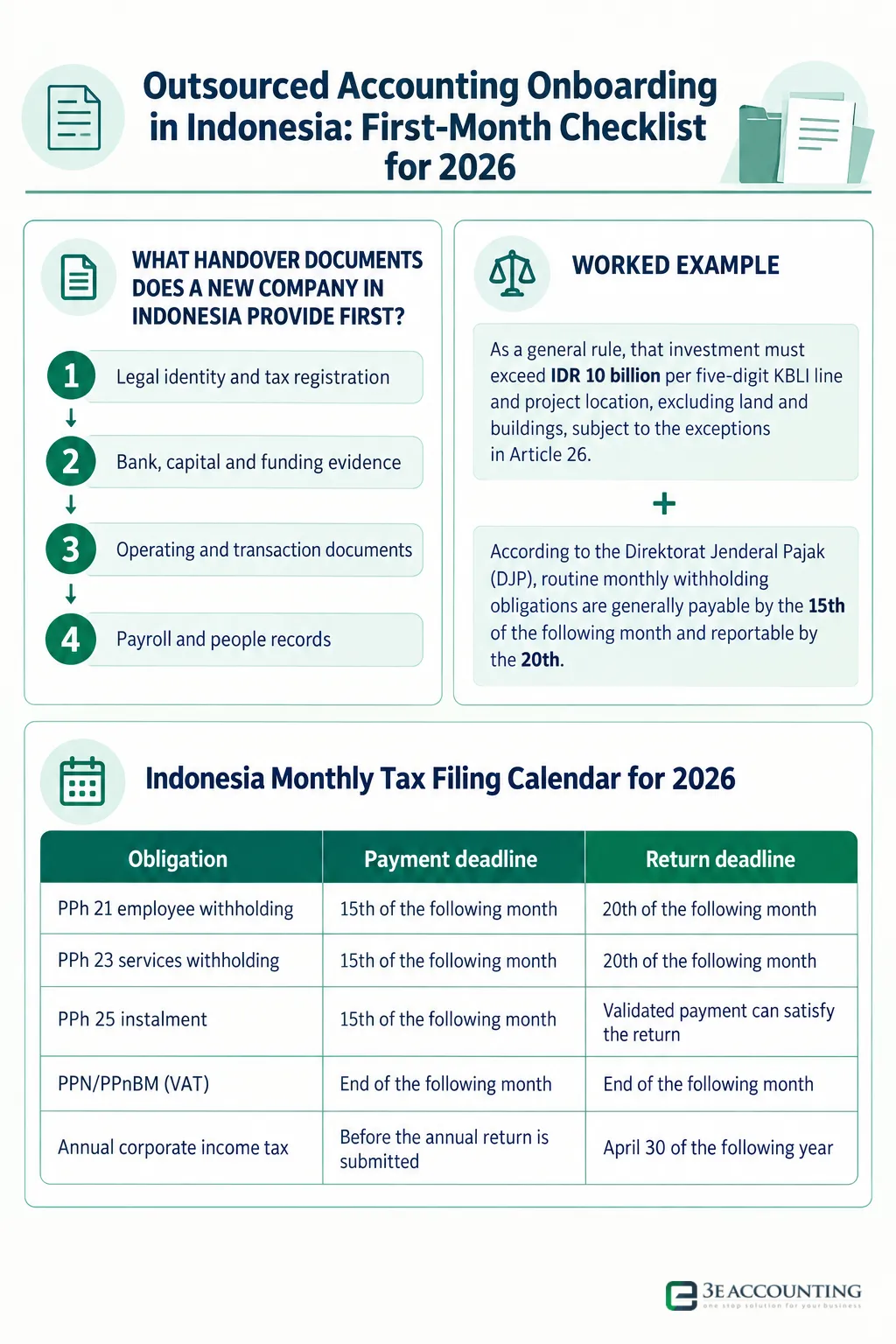
What Handover Documents Does a New Company in Indonesia Provide First?
Start with legal identity and tax registration records, then capital and bank evidence, then operating and payroll documents; the request list comes before any bookkeeping template.
The starting point is the company's legal identity, not the bookkeeping template. The list below is a general suggested handover checklist rather than a fixed firm policy or a legal minimum. The exact set depends on the company's activities, shareholding and registrations.
Every item is checked against the tax registration and Coretax profile before month one closes. That check covers the responsible person, registered obligations, the financial year and Pengusaha Kena Pajak (PKP) status as a VAT-registered enterprise.
One point deserves emphasis. A newly incorporated company can already have transactions before its company bank account exists, so founders should disclose and document those items rather than tidy them away.
1. Legal identity and tax registration
Collect the deed of establishment (akta) and any amendments. Also collect the Ministry of Law approval or acknowledgment through the AHU system. Collect the business identification number (NIB) with its KBLI classifications and the registered address. Add the company's tax identification numbers (NPWP), shareholder, director and commissioner details, an ownership chart, and evidence of subscribed and paid-up capital.
2. Bank, capital and funding evidence
Bank account-opening documents come next. Collect the following:
- every statement from account opening onward
- capital-transfer advices identifying who supplied the funds
- any schedule of founder-funded expenditure incurred before the account was active
3. Operating and transaction documents
Supplier invoices, customer contracts, sales invoices and expense claims are collected together. At the same time, agree the working rules: document submission standards, invoice numbering and expense approval limits.
4. Payroll and people records
Employment and contractor agreements, employee tax status, start dates and variable compensation complete the request. Payroll data that arrives late distorts the first employee withholding (PPh 21) calculation.
First-Month Handover Document Checklist
| Category | Documents to hand over | What it unlocks |
|---|---|---|
| Legal identity | Akta and amendments, Ministry of Law (AHU) approval, NIB and KBLI classifications | Ownership, signatories and registered activities |
| Tax registration | Company NPWP, registered address, Coretax profile, PKP status | Correct registered obligations and filing channels |
| Capital | Subscribed and paid-up capital evidence, shareholder remittance records | Opening equity and the funding classification |
| Banking | Account-opening documents, full statements, transfer advices | Bank reconciliation and cash cut-off |
| Operations | Supplier invoices, customer contracts, sales invoices | Expense, revenue and VAT records |
| Payroll | Employment contracts, employee tax status, variable pay | Accurate PPh 21 withholding from month one |
How Should Coretax, Bank and Software Access Be Delegated?
The client keeps ownership, approval rights and recovery credentials; the outsourced team works through separate named users with the minimum permissions each task needs.
Access is a governance question before it is a technical one. Under the current Coretax framework, the taxpayer's designated responsible person manages the entity's representation and authorises other named users, so roles follow the company's own appointments.
What follows is a suggested control framework, not a confirmed bank requirement. Each bank's available roles and the client's access model must be checked in every case before month one.
1. Coretax roles and representation
The client's designated responsible person controls the entity's representation in Coretax and authorises named users. Our corporate professional advisors prepare under delegated access, while submission and signing sit with the authorised role the company has actually assigned. Automatic filing authority should never be assumed.
2. VAT invoicing channels
A company confirmed as a PKP issues its tax invoices (faktur pajak) through Coretax, e-Faktur Client Desktop, or a host-to-host channel with an authorised application provider (PJAP). The channel applicable to that taxpayer is confirmed before month one, and issuance and correction rights are expressly assigned.
3. Bank statements and treasury
Client treasury supplies statements or grants a separate read-only banking user where its bank supports one. The outsourced team holds no payment-release rights; if separate view access is unavailable, client-exported statements are used instead.
4. Credentials the client keeps
Recovery email and phone, bank administrator credentials, payment tokens and one-time passwords (OTP) stay with the client. Personal passwords are never shared, and formal delegation or power of attorney is obtained where electronic authorisation is needed. An access register records every user, with immediate revocation on departure.
Sample Access and Approval Matrix
| System | Client retains | Provider receives |
|---|---|---|
| Coretax | Responsible-person control and authorised signer | Delegated preparation access for named users |
| VAT invoicing | PKP registration and commercial invoice data | Preparation through the applicable authorised channel |
| Banking | Administrator credentials, payment tokens, OTPs | Exported statements or read-only view access |
| Accounting software | Administrator account and data ownership | Named preparer posting and reviewer access |
How Are Opening Balances and Founder Funding Reconciled?
Every opening balance is tied to a source document. Capital traces back to the akta and remittance evidence. Founder-paid costs sit in a documented payable until they are reimbursed.
The reconciliation follows a simple discipline. The bank receipt of paid-up capital is matched to shareholder remittance evidence and the shareholder register: debit bank, credit paid-up capital. The akta alone is never treated as proof that cash was received.
If a director pays setup services or equipment before the account is active, retain the company's acceptance and supplier invoices. Those documents support debits to expense and equipment, with a credit to the amount due to the director. Reimbursement from the company bank then clears that payable. At takeover, the trial balance ties bank, equipment and expenses to paid-up capital and any accumulated loss. Depreciation and tax adjustments are assessed separately.
One caution applies to foreign-owned companies. The opening balance discussion above concerns the company's own recorded structure, while the minimum capital of a PT PMA in Indonesia is a separate statutory rule. Article 26 of Minister of Investment and Downstreaming/Head of BKPM Regulation No. 5 of 2025 sets this requirement. It generally requires at least IDR 2.5 billion in issued and paid-up capital for a PT PMA, unless another statutory provision provides otherwise. This was current as of October 2026. It is separate from the general minimum total investment. As a general rule, that investment must exceed IDR 10 billion per five-digit KBLI line and project location, excluding land and buildings, subject to the exceptions in Article 26.
First-month cut-off is then assessed by the underlying economic event, rights and obligations, not simply the date the bank account was activated or receipts were uploaded. That is a general accounting lens rather than a definitive rule, and material or pre-incorporation items need qualified accounting, tax and legal review.
1. Classify founder funding before booking it
Founder transfers are examined before posting. An unexplained transfer could be capital, a loan or revenue, and only the remittance advice, agreements and company records settle which. Each injection is classified from its facts and documents.
2. Separate recognition from deductibility
Accounting recognition of a founder-paid cost does not itself establish tax deductibility or input-VAT eligibility. Founder-paid costs, capital injections, shareholder loans, accruals, prepayments and pre-incorporation expenditure are each classified on their facts and supporting documents.
3. Preserve supplier tax details and faktur pajak
Input-VAT creditability depends on statutory conditions, including PKP status, a business connection and compliant documentation. Supplier tax information and tax invoices are therefore preserved from month one rather than retrieved later.
Which Monthly Tax Returns Are Due in Month One?
Only the returns the company's registration actually requires. A PKP files VAT monthly even without transactions. An entity not registered as a PKP does not carry that obligation.
The first filing is identified from the Coretax profile and the company's activities, not from assumptions. It is wrong to assume that every new PT must file VAT returns, or that every tax type needs a nil return; the registered obligations decide.
According to the Direktorat Jenderal Pajak (DJP), routine monthly withholding obligations are generally payable by the 15th of the following month and reportable by the 20th. The PPh 25 instalment is generally due on the 15th. A validated payment can itself satisfy the relevant return mechanism. Nil instalments and certain other cases may still require reporting. VAT payment and the VAT return are generally due by the end of the following month, before submission of the return.
A company already confirmed as a PKP must submit the monthly VAT return by month-end even where it made no transactions in the period. Under DJP guidance current as of October 2026, a business must report its business to DJP to be confirmed as a PKP. This applies once annual gross turnover exceeds IDR 4.8 billion. The confirmation is due by the end of the following month. In 2026 the statutory VAT rate under PMK No. 131 of 2024 is 12 percent, with most non-luxury supplies effectively charged at 11 percent on the 11/12 tax base.
The annual corporate income tax return falls due on April 30 for calendar-year entities. The standard rate is 22 percent for 2026. A possible two-month extension is available through the tax portal.
What Does a Practical First-Month Close Timetable Look Like?
Document cut-off, bank reconciliation, draft financials, then client approval, measured in business days, with statutory dates checked separately against the actual calendar.
A workable close needs an explicit timetable, because statutory dates are fixed but evidence is not. The pattern below is an illustrative planning example: internal working targets, not a service level and not a statutory deadline. The applicable calendar, holiday treatment and any exceptions must be checked for the specific taxpayer and period.
The close pack then includes payment validation and electronic filing receipts, not merely screenshots of draft returns. The client owns source completeness, business explanations, commercial approvals and funding the tax payment; the provider owns posting, reconciliation, calculation, preparation and the agreed submission work.
Companies meeting audit criteria should also plan early for statutory financial auditing and reporting services in Indonesia. The annual report must be ratified by an AGMS within six months of fiscal year end. Building that habit in month one avoids a year-end scramble.
1. Document cut-off (around BD2)
The client delivers complete bank statements, invoices, expense claims, payroll changes and a signed missing-document declaration, so gaps are visible instead of implied.
2. Bank reconciliation (around BD4)
The outsourced team completes the bank reconciliation and resolves funding and reimbursement queries while there is still time to correct them.
3. Draft financials (around BD6)
Draft financials and tax reconciliations are issued, and missing evidence is escalated before this point rather than silently carried into filing day.
4. Approval, payment and filing (around BD8)
The client approves corrections and the tax-payment pack and funds the payment. The team then arranges filing once the required approvals and payment evidence are available.
Indonesia Monthly Tax Filing Calendar for 2026
| Obligation | Payment deadline | Return deadline | Notes |
|---|---|---|---|
| PPh 21 employee withholding | 15th of the following month | 20th of the following month | Withheld from employee salaries |
| PPh 23 services withholding | 15th of the following month | 20th of the following month | 2 percent for domestic recipients; non-residents fall under PPh 26 |
| PPh 25 instalment | 15th of the following month | Validated payment can satisfy the return | Nil instalments may still require reporting |
| PPN/PPnBM (VAT) | End of the following month | End of the following month | A PKP files monthly even with no transactions |
| Annual corporate income tax | Before the annual return is submitted | April 30 of the following year | Standard rate of 22 percent for 2026 |
Which Handover Gaps Should a Founder Check First?
Founder-funded expense schedules, early bank evidence and identity-data mismatches are the weak points an onboarding team looks for first.
From routine onboarding work, our corporate professional advisors look at three recurring weak points before anything else. These are general observations from practice, not measured statistics.
Founder-funded expense schedules frequently arrive incomplete, and the missing bank evidence is often the very first statement or the remittance identifying who supplied the capital. Identity fields are the second weak point. Mismatches appear between incorporation documents, the tax profile and operating records. These mismatches may involve the legal name, address, director details or the tax identifier, not simply an absent NPWP certificate.
Missing akta amendments can leave the wrong ownership or authorised signatory in use. Payroll is the third weak point, because employee tax status, start dates and variable compensation often arrive after the first calculation.
The downstream effects are worth naming as risks to investigate, not documented outcomes. An unexplained founder transfer can be booked as revenue or capital when it is actually a loan. A founder's personal card payment can drop out of the accounts. A supplier invoice without usable tax details can delay withholding documentation or a VAT-credit review. A labelled exception list always beats a folder presented as complete.
Illustrative First-Month Close Timeline
| Working day | Step | Owner |
|---|---|---|
| BD2 | Client delivers complete statements, invoices, claims, payroll changes and a missing-document declaration | Client |
| BD4 | Bank reconciliation completed; funding and reimbursement queries resolved | Provider |
| BD6 | Draft financials and tax reconciliations issued; missing evidence escalated | Provider |
| BD8 | Client approves corrections and the tax-payment pack | Client |
| After approval | Payment arranged by the statutory deadline; filing completed on approvals and payment evidence | Provider |
How Can a Founder Test Onboarding Readiness Before Filing?
Trace one funding receipt, one supplier expense and one customer transaction from source document to approval, and the hidden gaps surface quickly.
One practical self-check is suggested here as a rehearsal rather than a validated methodology. Trace a single funding receipt, a single supplier expense and a single customer transaction end to end. Each item is followed from source document to bank movement, accounting classification, tax treatment and the named person who approves it.
Governance belongs to the founder, not the provider. The client retains the source documents and personally signs off the funding classification, the reimbursement liability and the opening-balance schedule. The provider recommends the accounting treatment; the decision to accept it stays with the company.
Conclusion
A first month decides whether a company in Indonesia starts with evidence or guesses. The handover package should cover legal identity, tax registration, capital and bank evidence, transactions and payroll. Disciplined Coretax and bank access, reconciled opening balances and a clear approval matrix help make the first monthly filing routine.
3E Accounting Indonesia is a Corporate Services Provider supporting startups, SMEs and multinational companies in Indonesia. It provides company incorporation, accounting, tax, payroll and corporate secretarial services. The 3E Accounting International Network supports its work across more than 110 countries. Outsourced accounting onboarding for new PT and PT PMA entities is part of our corporate professional advisors' day-to-day client work.
If you are preparing a first-month handover, speak with our team about the documents, access and opening balances your company should have ready before its first filing.
Get Month One Right From Day One
Talk to 3E Accounting Indonesia about a structured first-month handover for your new PT or PT PMA.
Frequently Asked Questions
According to DJP deadline guidance for 2026, routine PPh 21 and PPh 23 withholding is generally payable by the 15th of the following month and reportable by the 20th. The PPh 25 instalment is generally due on the 15th, and VAT payment and the VAT return are generally due by the end of the following month. The specific calendar, exceptions and any later rule changes must always be checked.
Only if it is registered as a PKP. A taxpayer confirmed as a PKP must submit the monthly VAT return by the end of the following month even with no transactions. An entity not registered as a PKP does not carry this VAT obligation, and all other return obligations are determined taxpayer by taxpayer.
The client should keep recovery contacts, bank administrator credentials, payment tokens and one-time passwords. The provider works through separate named users with minimum permissions, with roles subject to the taxpayer's actual Coretax appointments and each bank's available access model.
No. The bank receipt and shareholder remittance evidence must match the akta and the shareholder register before capital is booked. Founder funding is classified as capital, a loan or an expense from the facts and documents, with the client signing off the classification.
Founder-funded expense schedules, the earliest bank statements and the remittance identifying the capital source, plus identity mismatches between incorporation, tax and operating records. Payroll inputs such as employee tax status and start dates also often arrive late; a labelled exception list always beats a folder presented as complete.

Abigail Yu
Director
Abigail Yu oversees executive leadership at 3E Accounting Group, leading operations, IT solutions, public relations, and digital marketing to drive business success. She holds an honors degree in Communication and New Media from the National University of Singapore and is highly skilled in crisis management, financial communication, and corporate communications.