
What Do Indonesia Payroll Tax Rates 2026 Mean for Employers?
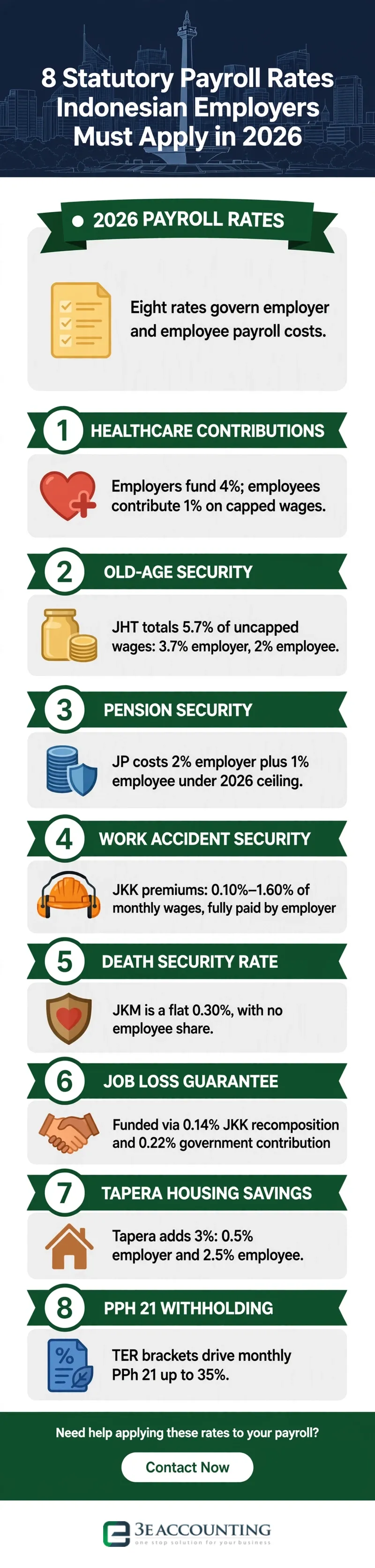
Any employer running payroll in Indonesia in 2026 has eight statutory rates to apply, including BPJS social insurance, BP Tapera housing savings and PPh 21 withholding. BPJS administers six contributions, BP Tapera administers one, and the Direktorat Jenderal Pajak (DJP) collects the remaining income tax. Add the core employer shares — 4%, 3.7%, 2%, 0.30% and the JKK risk premium — and each hire costs well over its gross salary; the 0.5% Tapera employer framework is not yet a universal active mandate while the Court-ordered transition continues. In this infographic, we set out the eight statutory payroll rates to apply across Indonesia in 2026, with the employer and employee split for each.
What Are BPJS Kesehatan Contributions?
Employers contribute 4% of monthly wages for BPJS Kesehatan coverage, deducting a further 1% from each employee. Both shares are calculated on monthly wages up to Rp12 million for private-sector workers. This is the statutory ceiling for the national health insurance (JKN) programme. Enrolment is a legal condition of formal employment, so every registered worker and their dependents must be covered from the start of employment.
What Is Old-Age Security (JHT)?
Jaminan Hari Tua (JHT) costs 5.7% of gross monthly wages: 3.7% employer-paid and 2.0% employee-withheld. No statutory wage ceiling applies, so the full percentage runs on every rupiah of salary. Balances accrue in each worker's BPJS Ketenagakerjaan account as a core long-term benefit. Growing teams cannot drop the scheme, and late remittance attracts administrative sanctions under the social security regime.
What Is Pension Security (JP)?
Jaminan Pensiun (JP) carries a 3% charge, split 2% employer and 1% employee, on capped wages. From March 1, 2026, the monthly wage ceiling is Rp11,086,300. Update the contribution base before running payroll rather than reusing last year's cap. Amounts above the ceiling are excluded from JP contributions; monthly pension benefits are subject to statutory eligibility conditions, while workers who do not meet them receive a lump sum. Payroll ledgers should reconcile with the figures in your statutory financial statements.
Work Accident Security JKK
Among Indonesia's statutory payroll rates, JKK premiums range from 0.10% to 1.60% of monthly wages and are paid entirely by the employer. The exact percentage depends on the occupational risk class BPJS Ketenagakerjaan assigns, from low-risk office work to high-risk construction and mining. Employees contribute nothing, but misstating the class leaves underpaid premiums, and the scheme funds medical care and compensation for workplace accidents and occupational disease.
Indonesia payroll contribution summary for 2026
| Programme | Employer treatment | Employee treatment | Wage basis or note |
|---|---|---|---|
| BPJS Kesehatan | 4% | 1% | Rp12 million monthly ceiling for private-sector workers |
| JHT | 3.7% | 2% | No wage ceiling |
| JP | 2% | 1% | Rp11,086,300 monthly ceiling from March 1, 2026 |
| JKK | 0.10%-1.60% | None | Rate depends on occupational risk class |
| JKM | 0.30% | None | No wage ceiling |
| JKP | No additional premium | None | 0.14% from JKK and 0.22% from the central government |
| Tapera | 0.5% framework | 2.5% framework | Implementation subject to the Court-ordered transition |
| PPh 21 | Withholds and reports | Tax withheld using TER | Annual progressive rates are 5%-35% in the final tax period |
Death Security JKM
Jaminan Kematian (JKM) is fixed at 0.30% of monthly wages and fully employer-funded. No wage ceiling and no employee deduction apply, so budgeting is straightforward. The scheme pays a funeral benefit and periodic allowances to a deceased worker's surviving spouse and children for a defined term. These benefits give families a statutory safety net alongside any private life cover the company provides.
Job Loss Guarantee JKP
JKP is funded through a 0.14% recomposition of JKK contributions and a 0.22% contribution from the central government. No additional premium is charged to the employer, and no deduction is taken from staff. The scheme reallocates part of the social security contributions already remitted. Coverage supports workforce planning: eligible workers who lose employment receive cash benefits plus access to training and job-matching services.
Tapera Housing Savings
Government Regulation No. 25 of 2020 sets out a 3% Tapera contribution framework: 0.5% employer-paid and 2.5% employee-paid. However, the Constitutional Court ruled on September 29, 2025 that the Tapera law must be restructured within two years. Employers should therefore not treat Tapera as an active universal payroll mandate without confirming the applicable implementation rules. BP Tapera continues to provide services during the transition.
PPh 21 Tax Withholding
PPh 21 uses monthly Effective Tax Rate (TER) brackets for withholding from January through November. The TER is separate from the 5% to 35% annual progressive rates, which apply in the final tax period. TER has applied since January 2024 under Government Regulation No. 58 of 2023, and payroll reporting uses the Direktorat Jenderal Pajak (DJP) Coretax system. In the final tax period, withholding is calculated under the annual progressive scale. Each worker's tax identification number (NPWP) and non-taxable income (PTKP) status must stay current.
Need Help Applying 2026 Payroll Rates in Indonesia?
Our corporate services team supports BPJS enrolment, Tapera requirement assessments and Coretax-ready PPh 21 payroll for clients across Indonesia.
Frequently Asked Questions
The total employer contribution for BPJS Ketenagakerjaan in 2026 is 6.10% to 7.60% of monthly wages. Employers pay 3.7% JHT, 2% JP, 0.10%-1.60% JKK and 0.30% JKM, while JKP adds no extra premium because it is funded through a 0.14% recomposition of JKK contributions and a 0.22% central government contribution. Employees contribute 2% JHT and 1% JP.
Yes. Formal-sector workers must be enrolled, with the employer contributing 4% and the employee 1%, calculated on monthly wages up to the statutory cap.
Not as a universal payroll requirement. On September 29, 2025, the Constitutional Court required the Tapera law to be restructured within two years, so employers should confirm the applicable implementation rules before withholding.
Monthly amounts are withheld using the standardized TER brackets and filed through the DJP Coretax system, then reconciled against the progressive 5%-35% annual scale at year end.
BPJS Kesehatan is capped at Rp12 million monthly for private-sector workers, and JP at Rp11,086,300 monthly from March 1, 2026. JHT, JKK and JKM have no cap. Tapera implementation remains subject to the Court-ordered transition.

Abigail Yu
Director
Abigail Yu oversees executive leadership at 3E Accounting Group, leading operations, IT solutions, public relations, and digital marketing to drive business success. She holds an honors degree in Communication and New Media from the National University of Singapore and is highly skilled in crisis management, financial communication, and corporate communications.