


What Must PKPs in Indonesia Include on a Tax Invoice?
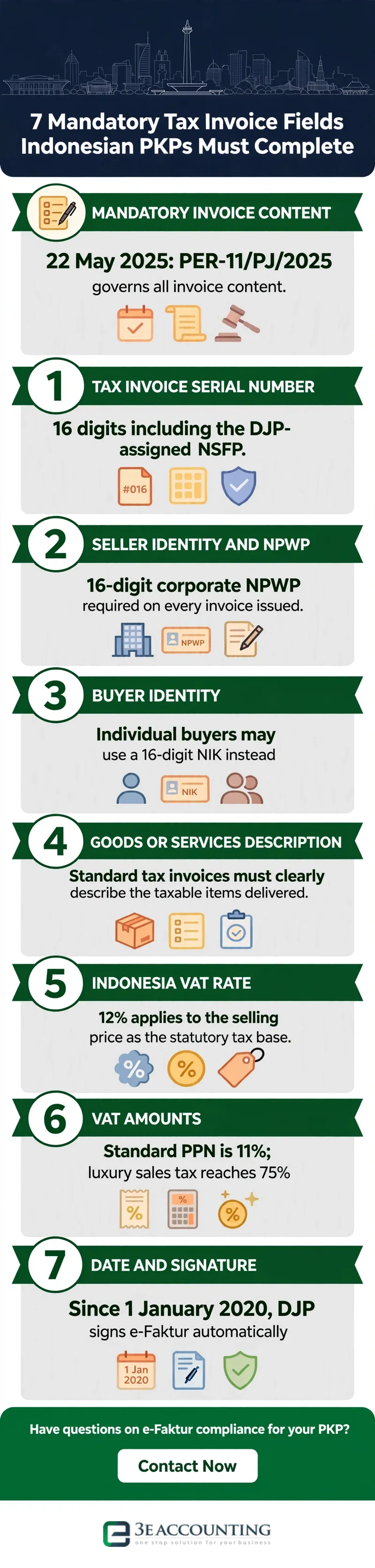
Since 22 May 2025, Director General of Taxes Regulation PER-11/PJ/2025 has governed Indonesian tax invoice content for Pengusaha Kena Pajak (PKPs), or VAT-registered Taxable Entrepreneurs. The seven fields are the Tax Invoice Serial Number; seller identity and NPWP; buyer identity; goods or services description; selling price and Tax Base (DPP); VAT and Luxury Tax; and issuance date and signature. In this infographic guide, we explain seven PKP tax invoice fields required before an e-Faktur can be validated. We also explain what each requirement means for day-to-day invoicing. Missing or incorrect PKP tax invoice fields can make the VAT uncreditable for the buyer and may result in administrative sanctions for the seller. Our team provides e-Faktur compliance support.
What Is the Tax Invoice Serial Number?
16 digits make up a Tax Invoice code and number, including the NSFP assigned by the Directorate General of Taxes (DJP) to the issuing seller. An e-Faktur becomes a Tax Invoice after it receives DJP approval. A Tax Invoice with a missing required NSFP is formally incomplete, while an e-Faktur that does not obtain DJP approval is not a Tax Invoice. Businesses should verify the number before releasing any document to buyers.
Which Seller Identity and NPWP Details Are Required?
A corporate Taxpayer Identification Number (NPWP) uses 16 digits and must appear on every tax invoice the seller issues. The seller's registered business name and official tax address must also match DJP records exactly. Mismatches between invoice details and NPWP registration data are common reasons for buyer rejection. They can cause buyers to lose input VAT credit during verification.
Which Buyer Identity Details Are Required?
16-digit National Identification Number (NIK) can identify a domestic individual buyer instead of an NPWP. PER-11/PJ/2025 permits a domestic individual buyer to be identified using an NPWP or a 16-digit NIK. Domestic corporate buyers require their registered name, address and NPWP, while foreign corporate buyers require their name and address. These details must match their tax registration records for the input VAT to remain creditable.
Goods or Services Description
A standard Tax Invoice requires a clear description of the taxable goods or services delivered, covering the type, quantity and unit price of each line item. A simplified Tax Invoice for retail supplies to final consumers may omit buyer identity and the name and signature of the person authorised to sign it. Vague wording or generic trade terms weakens the buyer's VAT position during a DJP audit, so describe every item precisely as transacted.
PKP tax invoice field checklist
| Field | What the invoice must show | Key control |
|---|---|---|
| Tax Invoice Serial Number | DJP-assigned NSFP | Verify it before releasing the invoice |
| Seller identity and NPWP | Registered name, tax address and 16-digit NPWP | Match DJP registration records |
| Buyer identity | 16-digit NIK for individuals or registered corporate details | Keep tax identity details accurate |
| Goods or services | Type, quantity and unit price | Describe each item precisely |
| Selling price and DPP | Selling price before VAT and recorded discounts | Show reductions directly on the invoice |
| PPN and PPnBM | Separate PPN and PPnBM amounts | Apply the relevant VAT treatment |
| Issuance date and signature | Correct tax period date and automatic DJP signature | Confirm the date before reporting |
Selling Price and Tax Base
12% is Indonesia's statutory VAT rate. Under PER-11/PJ/2025, for most non-luxury goods and services, the Tax Base (DPP) is 11/12 of the selling price (the “other tax base”), so the effective VAT charge is 11%; for luxury goods and services, the DPP is the full pre-VAT selling price, so the 12% rate applies. Discounts and rebates must be recorded directly on the invoice. This reduces the DPP correctly. Reductions shown only on a separate document cannot be deducted. Businesses should maintain prices in an invoicing system with clear controls at this step. Accurate PKP tax invoice fields help ensure the stated DPP can be verified.
VAT and Luxury Tax
Since 1 January 2025, Indonesia's statutory Value Added Tax (PPN) rate has been 12%. For most non-luxury goods and services, an 11/12 other-tax-base formula generally results in an effective 11% charge. Goods classified as luxury may also attract Sales Tax on Luxury Goods (PPnBM). Statutory PPnBM rates can reach 75%, depending on the product category. The invoice must display the exact PPN and any PPnBM as separate figures. Combined amounts prevent buyers from claiming a verifiable input credit against their own output tax.
Issuance Date and Signature
Since 1 January 2020, the DJP has applied the certified digital signature automatically through the e-Faktur application. Sellers no longer use their own digital certificates for this purpose. The issuance date determines the tax period. It also drives the monthly reporting deadline. Use Indonesia time zone controls when confirming the issuance date. An incorrect date can misstate the seller's output VAT and the timing of the buyer's credit.
Need Help With e-Faktur Compliance?
Our Corporate Services Provider team supports PKPs across Indonesia with tax advisory, accounting and e-Faktur administration from incorporation onward.
Frequently Asked Questions
The DJP treats an incomplete invoice as though it was never issued. The buyer may lose the input VAT credit unless the invoice is corrected or replaced as required before credit is claimed, and the seller may face administrative sanctions for issuing a non-compliant document.
Yes. Under PMK-151/PMK.03/2022, effective since 1 April 2023, a 16-digit National Identification Number (NIK) can be recorded for individual buyers instead of an NPWP.
Since 1 July 2016, the DJP has assigned serial numbers (NSFP) electronically through the e-Faktur application rather than at the tax office.
Since 1 January 2025, the statutory PPN rate is 12%. For most non-luxury goods and services, the 11/12 other-tax-base formula generally produces an effective 11% charge. Luxury goods may also attract PPnBM at statutory rates up to 75%.
No. Since 1 January 2020, the DJP applies the certified digital signature automatically when the invoice is validated in the e-Faktur application.

Abigail Yu
Director
Abigail Yu oversees executive leadership at 3E Accounting Group, leading operations, IT solutions, public relations, and digital marketing to drive business success. She holds an honors degree in Communication and New Media from the National University of Singapore and is highly skilled in crisis management, financial communication, and corporate communications.