
A company's existing manpower record does not necessarily follow its sole office to another district. In Indonesia, employers must update WLKP after an office relocation and file two separate statutory reports around the move.
In this blog, we discuss what Law No. 7 of 1981 requires when a company relocates, which reports fall due before and after the move, how the labor office and the Berita Acara Perpindahan fit in, and how the WLKP administrator updates the record — with suggested documents and checks for verifying the new address.
Why Does a WLKP Company Address Change Involve More Than the Portal?
An office relocation is a statutory reporting event under Law No. 7 of 1981. The employer must notify the manpower authorities — not merely edit a field online.
WLKP stands for Wajib Lapor Ketenagakerjaan, the mandatory written report on a company's manpower condition. Law No. 7 of 1981 requires it when a company is established, resumes operations, relocates, or closes. The Ministry of Manpower (Kemnaker) administers the obligation through its online reporting ecosystem, including the SIAPkerja platform.
To update WLKP after an office relocation in Indonesia across district lines, employers should confirm how the competent authorities will handle the existing record.
The law treats relocation as a distinct reporting event with its own deadlines, which we set out below.
First-time reporters face a different question. Under Permenaker No. 4 of 2019, an employer completing its first manpower report through OSS receives an NIB that also serves as the WLKP reporting number if the data is complete and correct, as our Bahasa Indonesia guide to the first WLKP report and its statutory deadlines explains. This article instead addresses employers that already hold a WLKP record.
Which WLKP Reports Are Due Before and After an Office Relocation?
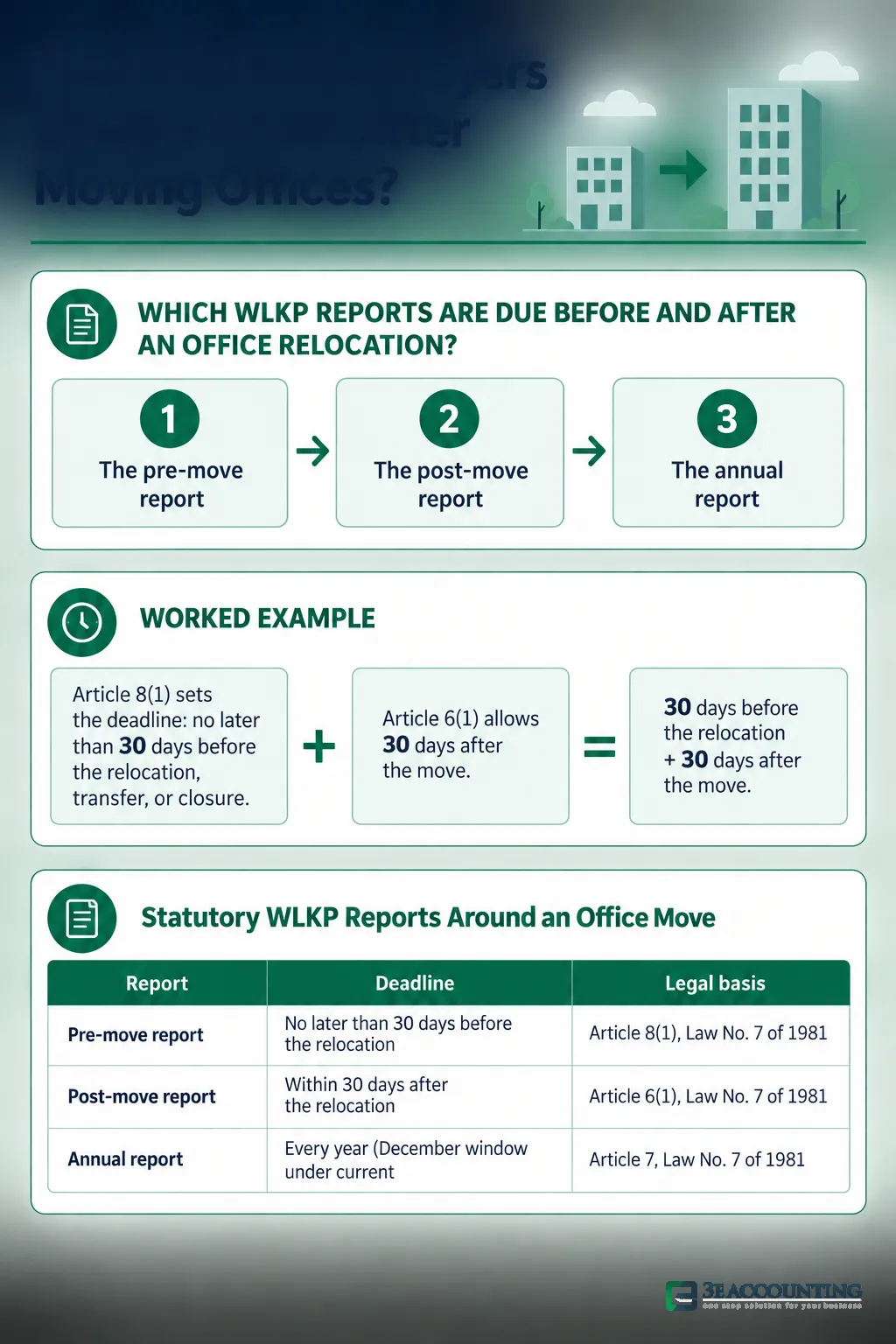
Two event reports apply: one no later than 30 days before the move, and another within 30 days after it. The annual report continues in parallel.
Both clocks run from the move itself. Article 8(1) of Law No. 7 of 1981 requires an employer to report a planned relocation, closure, or transfer no later than 30 days before the event. Article 6(1) then requires a fresh report within 30 days after the company relocates.
The post-move report carries the standard content under Article 6(2): company identity, labor relations, labor protection, and employment opportunities. Article 7 keeps the recurring obligation alive, because WLKP reporting is annual. As of November 2026, Manpower Ministerial Regulation (Permenaker) No. 18 of 2017, as amended by Permenaker No. 4 of 2019, sets the December reporting window. Confirm the portal's live flow each year before relying on it.
Article 10 of Law No. 7 of 1981 must be read with Law No. 1 of 2026, effective 2 January 2026, which removes detention from provisions prescribing detention and a fine and adjusts the fine to the applicable category. Enforcement varies case by case, so employers should not treat the maximum as a quotation for their own situation.
One point deserves emphasis: the NIB amendment date is not the statutory trigger. The clocks above run from the relocation as the law defines it. That reading is our interpretation of Articles 6 and 8. Confirm how the competent authority accepts each report for the particular move, and do not delay a statutory report while waiting for an NIB correction.
1. The pre-move report
Article 8(1) sets the deadline: no later than 30 days before the relocation, transfer, or closure. Employers should date-stamp this filing ahead of the physical move, because the post-move report does not excuse a missing pre-move notice.
2. The post-move report
Article 6(1) allows 30 days after the move. The report should reflect the new premises and current employee data. Confirm how to file it with the competent authority, and do not delay it while waiting for the record or NIB to be updated.
3. The annual report
Article 7 keeps reporting annual. The December window sits in the compliance calendar, but it is not permission to postpone a relocation update to the anniversary of the old report.
Statutory WLKP Reports Around an Office Move
| Report | Deadline | Legal basis |
|---|---|---|
| Pre-move report | No later than 30 days before the relocation | Article 8(1), Law No. 7 of 1981 |
| Post-move report | Within 30 days after the relocation | Article 6(1), Law No. 7 of 1981 |
| Annual report | Every year (December window under current rules) | Article 7, Law No. 7 of 1981; Permenaker No. 18 of 2017 |
Which Labor Office Should an Employer Contact First?
The safe starting point is the manpower office for the company's location, with routing confirmed in writing. Published guidance does not settle which district acts first.
To update WLKP after an office relocation in Indonesia, consult Kemnaker's help center FAQ on relocation for the official sequence. The employer reports the move to the local manpower office (Disnaker). A labor inspector then prepares a Berita Acara Perpindahan, the official record of the relocation. The record goes on to the central WLKP administrator, and the administrator updates the company's address in the national system.
That sequence answers the what, not the who-first. The FAQ does not say whether the old district, the new district, or a provincial office should receive the first contact, and it does not identify who transmits the record. Our practical approach — offered as professional judgment, not a national rule — is to ask the destination office to confirm jurisdiction, and to involve the originating office only where a release or clarification is genuinely needed.
Employers should also keep the distinction between regulatory direction and system permissions. Ask the local office about jurisdiction and procedure, and confirm with the administrator what assistance the portal update requires. For a company name or address change, the help centre asks the employer to contact the WLKP administrator with the latest NIB and company-change documents.
What Is the Berita Acara Perpindahan and Who Prepares It?
It is an official record drawn up by the manpower authority. An employer-supplied letter is not a substitute for it.
Under the help center route, the labor inspector prepares the Berita Acara Perpindahan once the employer reports the move. The employer's role is to supply accurate facts: the old and new addresses, the effective move date, company identity documents, and current employee data.
Two cautions follow. First, an employer-written relocation letter should never be presented as a Berita Acara. Where an office prescribes a form, signature sequence, or transmission step, follow its procedure. Second, confirm who signs and sends the record with the competent office; the FAQ does not identify the sender.
For companies also changing their name or other registration data, the help center directs employers to contact the WLKP administrator with the latest NIB and company-change documents. That stated list is a starting point, not an exhaustive attachment schedule for every move.
Documents Commonly Requested for a WLKP Address Update
| Document | Why it matters |
|---|---|
| Latest NIB and OSS location details | Confirms the new premises and business classification |
| Deed of establishment and amendments | Proves company identity and management details |
| NPWP and KBLI codes | Aligns tax and business-line records with the labor report |
| Premises evidence (lease or domicile letter) | Substantiates the new address at district level |
| Relocation decision with effective date | Anchors the statutory reporting clocks |
| Employee data and BPJS details | Keeps the report's workforce figures accurate |
How Is the WLKP Record Updated After a Company Moves?
Preserve the old report, coordinate the NIB correction and statutory reports, and confirm the administrator-assisted update before checking the resulting record.
To update WLKP after an office relocation in Indonesia, our team recommends preserving the existing report and confirming the administrator-assisted route with the competent authorities. An older government manual describes general self-service editing: amend the company profile, save it, and use the reporting menu. This is historical guidance, not confirmation of which fields are editable today or that an employer can complete an inter-district relocation unaided.
Drawing on our team's professional experience, we first distinguish a relocation of an existing establishment from an additional office that leaves the original operating. We also check for address mismatches and avoid creating a duplicate record without direction. These are professional judgments, and the steps below are suggested checks, not a verified live portal walkthrough. Our guide to obtaining an NIB in Indonesia explains the registration context.
Step 1: Preserve the existing record
Keep the prior WLKP report, its reporting number, and the account details before any edit. This gives you a reference for checking the record and its reporting history after the update.
Step 2: Correct the NIB address in OSS
Correct the address associated with the company's business identification number (Nomor Induk Berusaha, NIB) in OSS and reconcile it with the labor record. Run the correction and labor reporting in parallel rather than delay a statutory report. Employers new to the system can start with our guide on how to obtain a company registration number NIB in Indonesia.
Step 3: Reconcile the address components
Compare the OSS location details against the premises evidence: province, regency or city, subdistrict, village, and postcode. Our team recommends explaining any mismatches and seeking corrections without delaying statutory reports.
Step 4: Request the administrator update
Contact the WLKP administrator about the existing record and confirm the assistance channel and required documents. Describe the old and new addresses and effective move date, and ask how to update the existing record rather than create a duplicate without direction.
Step 5: Verify and submit
As a suggested check, compare the company name, NIB, WLKP identifier, full new address and employee data with the supporting records. Confirm submission status and download the report where available; check the relevant fields and acknowledgements in the live system.
Step 6: Keep the evidence
Retain the ticket response, the Berita Acara, any office correspondence, the submitted reports and available acknowledgements for both relocation reports. A resolved ticket alone is not completion evidence, and an updated NIB does not by itself prove the WLKP record moved.
What Documents Should Employers Prepare for the Update?
The help center names the latest NIB and company-change documents; other records may help reconcile the relocation details.
The FAQ's stated list is a starting point, not proof of a complete attachment schedule for every inter-district move. Our team suggests considering the following records and confirming the required attachments with the competent office or administrator:
- The latest NIB and updated OSS location details
- The deed of establishment and its amendments
- The company tax number (NPWP) and KBLI business classifications
- Premises evidence, such as a lease or domicile letter
- The relocation decision, with the effective move date
- Current employee data: local and foreign worker counts, gender, and status splits
- BPJS registration details, where the portal requests them
Supporting documents should reconcile with each other before submission. Where the NIB address lags the physical move, see the scenarios below.
Relocation Scenarios and the Different Routes
| Scenario | Key difference |
|---|---|
| Move within the same district | Check self-edit rights first; both statutory reports still apply |
| Inter-district move | Administrator-assisted re-pointing of the WLKP record; Berita Acara route |
| Cross-province move | Destination jurisdiction check; confirm whether a provincial manpower supervision contact is relevant |
| Additional establishment opened | Separate treatment for independently standing branches under Article 4(2) |
| NIB address lags the move | Parallel OSS correction and labor reporting; disclose the actual move date |
How Do Same-District, Cross-Province, and Other Relocation Scenarios Differ?
Four scenarios deserve separate handling: a move within the same district, an inter-district move, a cross-province move, and a NIB that lags the physical move.
A playbook that fits one inter-district relocation does not fit every case. These are our practical defaults, and each should be confirmed against the live portal and the relevant offices before filing.
Employers unsure which scenario they face can contact us for a structured review of their WLKP record and reporting position.
1. A move within the same district
Test whether the employer account can update every relevant location field itself before requesting an administrator transfer. The statutory pre- and post-move reports still apply; self-service editing, where available, does not remove them.
2. An inter-district relocation
Use the administrator-assisted route to re-point the existing WLKP record, with the Berita Acara Perpindahan prepared by the manpower authority. Confirm the sequence with the competent offices rather than assume the old or new district controls the national portal.
3. A cross-province relocation
Check jurisdiction with the destination authority and confirm whether a provincial manpower supervision contact is relevant. Do not assume that reporting arrangements in the previous province automatically carry over.
4. A NIB that lags the physical move
Run the OSS correction and the labor reporting in parallel. Disclose the actual move date and explain the documentary mismatch; never backdate the move to fit the paperwork, and never wait past a reporting deadline.
Conclusion
A WLKP company address change is not a single edit. It involves two statutory reports and evidence that they were filed. Kemnaker's FAQ describes a Berita Acara Perpindahan and an administrator-assisted record update; confirm the procedure for the particular move with the competent authorities.
Our corporate services team in Indonesia can help relocating employers preserve their existing report, prepare an administrator request, reconcile NIB and address data, and check the resulting record. Where a point turns on interpretation, we confirm the position with the relevant authority before filing, rather than assume a rule applies.
Employers planning a move are welcome to contact us for a review of their WLKP status and the reports their relocation will trigger.
Review Your WLKP Before the Move
Our Indonesia corporate services team checks WLKP records, prepares the reports a relocation triggers, and verifies the update with the administrator.
Frequently Asked Questions
Not necessarily. An updated NIB does not by itself prove the WLKP record was updated, so employers should verify the WLKP record and retain evidence of each report.
No. Under Law No. 7 of 1981, the clocks run from the move itself: a report no later than 30 days before, and another within 30 days after. The NIB amendment date is not the statutory trigger.
No. The official record is drawn up by the manpower authority, typically by a labor inspector. The employer supplies the facts and supporting documents, and should not present its own letter as the record.
Article 10 of Law No. 7 of 1981 must be read with Law No. 1 of 2026, which removes detention from provisions prescribing detention and a fine and adjusts the fine to the applicable category. Enforcement varies by case, and a mismatched labor record is itself a practical compliance risk.
Yes. Article 7 keeps reporting annual, and the current ministerial rules set a December window. Relocation does not reset or suspend the recurring obligation.

Abigail Yu
Director
Abigail Yu oversees executive leadership at 3E Accounting Group, leading operations, IT solutions, public relations, and digital marketing to drive business success. She holds an honors degree in Communication and New Media from the National University of Singapore and is highly skilled in crisis management, financial communication, and corporate communications.