


Can a business address also serve as a tax-registration location? Under PER-7/PJ/2025, a virtual office may serve as the PKP registration place only when every condition is met; the single-location condition is often decisive.
In this blog, we discuss virtual office PKP registration Indonesia, including the conditions under PER-7/PJ/2025, the Rp4.8 billion threshold, DJP verification, and the effect of a second business location.
What Is PKP Status, and When Must a Company Register?
PKP (Pengusaha Kena Pajak) is taxable entrepreneur status. It lets a company collect VAT, issue tax invoices, and credit input VAT. It becomes mandatory once annual turnover exceeds Rp4.8 billion.
According to DJP guidance, a company must report its business for PKP registration no later than the end of the following month after the month in which its gross turnover or receipts exceed Rp4.8 billion in a financial year.
Businesses below the threshold may apply voluntarily. The same virtual-office location rules apply to voluntary applicants.
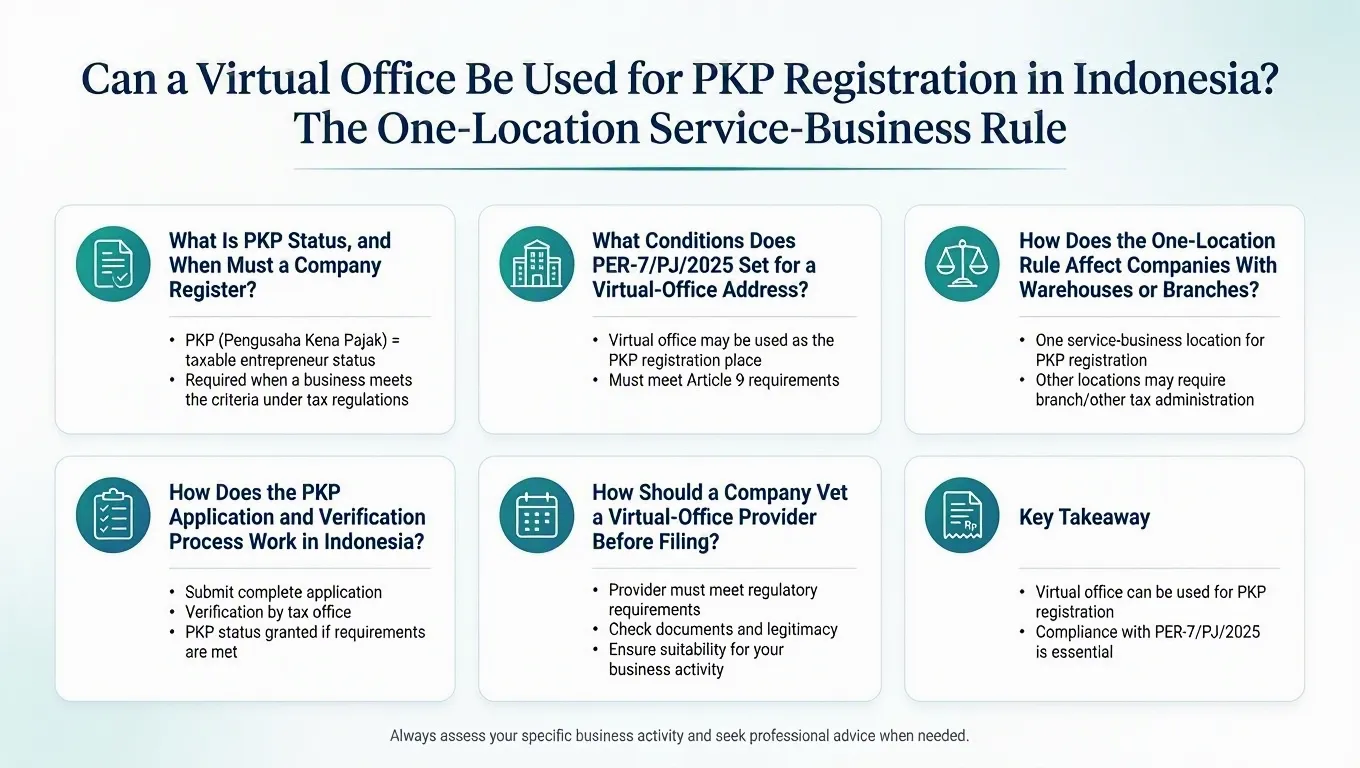
What Conditions Does PER-7/PJ/2025 Set for a Virtual-Office PKP Place?
A virtual office may be the PKP registration place under Article 51(1)(a) for a corporate taxpayer domiciled there with one business location there, or under Article 51(1)(b) for a corporate taxpayer domiciled in a free-trade zone and free port, subject to the respective conditions.
PER-7/PJ/2025 is a tax-administration regulation, not a blanket approval of every virtual-office arrangement or business licence. It opens a narrow lane, and every condition in it must be satisfied before the route works. DJP conducts office research after receipt and field research for specified PKPs; the virtual-office-provider requirements in Article 51(3) and (4) are tested in field research.
1. Domicile and the single-location test
These are cumulative conditions under Article 51(1)(a); Article 51(1)(b) provides a separate route for a corporate taxpayer domiciled in a free-trade zone and free port. A company with more than one place of business does not satisfy the ordinary route, however tidy its incorporation documents look.
2. The service-classification requirement
For the Article 51(1)(a) route, the taxpayer's principal business classification must be in the services field and the activity must be capable of being carried out at the virtual office; Article 51(1)(b) has separate free-trade-zone and free-port conditions. DJP assesses the taxpayer's actual principal activity rather than accepting a favourable label, so no specific KBLI code should be assumed to qualify automatically.
3. The one-year contract and genuine-use rule
The applicant must hold a virtual-office contract or similar document covering at least one year from the application date; the prohibition on using the address solely for correspondence applies to the Article 51(1)(a) route. A registered-address-plus-mail-forwarding arrangement does not meet the rule, however common it is in the incorporation market.
4. What the provider must supply
The provider must itself be a PKP, provide a physical workspace, genuinely provide office-support services, and hold its client contract plus a NIB or similar authority document. These are stated legal requirements for the route — not optional service features a provider can trade away for a lower price.
PER-7/PJ/2025 Conditions for a Virtual-Office PKP Place
| Condition | What It Requires |
|---|---|
| Taxpayer domicile | The company must be domiciled at the virtual office |
| Business locations | The virtual office must be the company's only place of business |
| Business field | Principal classification in services, with activity capable of being carried out at the address |
| Contract | A virtual-office contract or similar document covering at least one year from the application date |
| Use of address | The address cannot be used solely for correspondence |
| Provider status | Provider is a PKP with a physical workspace, genuine office-support services, contract and NIB or similar document |
How Does the One-Location Rule Affect Companies With Warehouses or Branches?
If a company domiciled at a virtual office has more than one place of business, its PKP registration must sit at another business location — not at the virtual office.
This rule is decisive for plans involving warehouses, shops, or branches. If a company is domiciled at a virtual office, it may have only one place of business. Otherwise, its PKP registration place is another business location. A separately recorded location does not preserve the virtual office as the PKP registration place.
Incorporation, OSS, spatial-planning, and sectoral licensing need separate confirmation for each case. This is an interpretation and a scope warning, not a universal virtual-office incorporation test.
1. Incorporation and licensing are assessed separately
Company-law registration and OSS or sectoral licensing follow their own rules. A virtual office may be acceptable for incorporation in some cases and not others. Spatial-planning (RDTR) restrictions and sector permits can override the address choice. This is a scope warning rather than a confirmed general rule. Any PT or PT PMA should obtain case-specific advice before committing to an address. A company registry search in Indonesia and a review of mandatory post-licensing filings for a PT PMA are useful starting points.
2. What this means for goods-based businesses
Trading, retail, and e-commerce profiles require advice on the specific facts. Under Article 51(2), a company with another place of business cannot use the virtual office as its PKP registration place. This limitation applies even when stock, sales, or fulfilment arrangements are separately documented.
3. Recording additional locations under Coretax
Additional-location records require case-specific confirmation before filing. Coretax procedures and the appropriate location record should be checked against current DJP guidance.
Single-Location Versus Multi-Location PKP Outcomes
| Business Profile | Where PKP Registration Sits |
|---|---|
| Service company domiciled at the virtual office with no other business location | The virtual office, if every PER-7/PJ/2025 condition is met |
| Company that also operates a warehouse, shop or branch office | Another business location — not the virtual office |
| Business whose activity cannot genuinely be carried out at the address | A location appropriate to the actual activity |
| Business below Rp4.8 billion applying voluntarily | The virtual office, subject to the same location rules as mandatory applicants |
How Does the PKP Application and Verification Process Work in 2026?
A complete PKP application from a virtual-office address must be decided within 10 working days of the receipt, and DJP follows up with field research in specified cases within 30 days.
The process under PER-7/PJ/2025 is administrative but demanding. Each stage has a defined scope and defined timing, and most delays trace back to a file that was incomplete or inconsistent at submission. The four steps below show the sequence and what DJP examines at each point.
Step 1: Assemble the application file
A corporate taxpayer applying through the virtual-office route must attach:
- A location map and photographs
- A statement of the actual business activity and the actual business place
- The qualifying virtual-office contract or similar document
The regulation lists these attachments. Longer evidence packs are not statutory checklists and should be confirmed with the relevant KPP before filing.
Step 2: Submit and secure the receipt
Applications are filed through the Taxpayer Portal, another DJP-integrated website or application, or the Contact Center; if electronic filing is not possible, they may be filed directly or sent by post, expedition company, or courier. The decision clock runs from the issuance of the receipt. It does not run from the first upload or from when an adviser considers the file complete. Chasing the receipt matters as much as the submission itself.
Step 3: Office research by DJP
DJP conducts office research into the taxpayer's identity and formation documents. It also examines activity documents, relevant attachments, and access to create tax invoices (faktur pajak). The scope follows PER-7/PJ/2025.
Step 4: Decision and follow-up field research
The KPP must decide within 10 working days after the receipt is issued. If it does not, the application is deemed granted. The PKP certificate must then be issued within one further working day.
For a newly confirmed or moved PKP, field research is scheduled within 30 days. For a virtual-office PKP, field research is conducted at the virtual office and, depending on the Article 51 category, at management's residence or the actual business place. Depending on the taxpayer's Article 51 category, it may also examine management's residence or the actual business place. Neither a video call nor a physical visit can be promised in a particular sequence. Field research remains part of the framework.
PKP Application Timeline Under PER-7/PJ/2025
| Stage | Timing or Requirement |
|---|---|
| Submission | Electronic filing or DJP Contact Center application |
| Receipt issuance | Decision clock starts when the receipt is issued |
| Office research | DJP examines identity, formation, activity documents, attachments and faktur pajak access |
| Decision | Within 10 working days of the receipt |
| Deemed grant | PKP certificate issued within one further working day if no decision is issued |
| Field research | Within 30 days of confirmation for specified new or moved PKPs |
Mandatory Provider Requirements Versus Suggested Checks
| Official PER-7/PJ/2025 Requirement | Suggested Practitioner Check (Not a DJP Rule) |
|---|---|
| Provider holds PKP status | Re-verify the provider's PKP certificate immediately before filing |
| Provider offers a physical workspace | Confirm a usable desk or private room and signage rights |
| Provider genuinely supplies office-support services | Test mail, telephone and reception arrangements in practice |
| Provider holds contract and NIB or similar licence | Check occupancy authority and spatial-planning permission at the location |
How Should a Company Vet a Virtual-Office Provider Before Filing?
The regulation makes four provider-side facts mandatory: PKP status, a physical workspace, genuine office-support services, and current contract and licensing documents.
Provider-side failures are among the most preventable reasons a virtual-office PKP application stalls. Because a provider's tax status can change between onboarding and filing, we advise clients to re-verify the baseline immediately before submission rather than trusting an earlier check. The layers below separate what the law requires from what experienced practitioners add on top.
1. Confirm the official baseline first
The provider must meet four official requirements:
- It must be a PKP
- It must offer a real physical workspace
- It must genuinely supply office-support services
- It must hold its client contract plus a NIB or similar authority document
These four points come straight from PER-7/PJ/2025. A provider that cannot evidence all of them cannot support a virtual-office PKP application.
2. Suggested due-diligence checks
Beyond the statutory baseline, a sensible due-diligence review — a suggested checklist, not DJP's official checklist — typically covers:
- Signage rights and a usable desk or private room at the address
- Occupancy authority from the building owner or manager
- Evidence that the relevant KBLI is permitted at the location under spatial-planning rules
- Mail, telephone and reception arrangements that operate in practice
- The provider's willingness to host a verification visit and supply its PKP evidence
These items strengthen a file; they are not universal legal requirements under the regulation.
3. Red flags that end the review
A non-PKP provider, a mail-only arrangement, or no physical workspace does not meet the stated requirements. A provider that cannot support verification or provide supporting documents may create application risk. These are practical screening points, not a statement that DJP maintains a public address blacklist.
Conclusion
For PKP purposes, a virtual office can be the registration place only through the narrow route in PER-7/PJ/2025. The corporate taxpayer must be domiciled there. It must have one business location. It must meet the service-activity requirements. It must hold a qualifying contract with a compliant provider. A company with a second place of business must register its PKP at another business location.
The practical work sits in the preparation:
- Matching the business classification to the address
- Evidencing genuine use
- Vetting the provider against the statutory baseline
- Assembling a file that survives office research and field research
We help clients settle their address strategy before incorporation. We vet virtual-office providers against the PER-7/PJ/2025 requirements. We manage PKP applications and location recording under Coretax end to end.
If you are weighing a virtual office against a physical premises for your PT or PT PMA, contact our tax team. We can assess the PKP virtual office requirements against your actual activity, locations and turnover position before anything is filed.
Settle Your Address Strategy Before You File
Our tax team reviews your business classification, operating locations and provider documents against PER-7/PJ/2025, so your PKP application is positioned correctly from the start.
Frequently Asked Questions
For PKP purposes, PER-7/PJ/2025 permits a corporate taxpayer to use a virtual office as its PKP registration place. The taxpayer must meet every stated condition. These include domicile there, one place of business, a principal service activity that can be carried out there, and a qualifying one-year contract with a compliant provider.
PKP registration becomes mandatory once annual gross turnover exceeds Rp4.8 billion in a financial year. The company must report itself no later than the end of the following month. Below the threshold, PKP status is voluntary but subject to the same location rules.
Not automatically. If the company operates the warehouse as another place of business, it cannot use the virtual office as its PKP registration place under Article 51(2). This is a fact-specific tax-administration rule, so advice should confirm the business locations.
Field research remains part of the PKP-administration framework. For newly confirmed or moved PKPs it is scheduled within 30 days, and for virtual-office PKPs it may examine the virtual office and, depending on the taxpayer's Article 51 category, the management's residence or the actual business place. No particular sequence of video or physical verification can be promised.
The tax office (KPP) must decide a complete application within 10 working days after the receipt is issued. If no decision is issued in that period, the application is deemed granted and the PKP certificate must be issued within one further working day.

Abigail Yu
Director
Abigail Yu oversees executive leadership at 3E Accounting Group, leading operations, IT solutions, public relations, and digital marketing to drive business success. She holds an honors degree in Communication and New Media from the National University of Singapore and is highly skilled in crisis management, financial communication, and corporate communications.