



Does a foreign-owned company in Indonesia with zero revenue still need shareholder approval and a Ministry of Law filing? Yes — dormancy is not an exemption, and the entire chain runs on a statutory clock set by Regulation No. 49 of 2025.
In this article, we discuss the PT PMA annual report filing process from preparation to submission. It covers report contents, shareholder decisions, notarial deeds and SABH submissions. It also explains planning for dormant, service and trading companies, plus late-filing consequences.
What Must a PT PMA Annual Report Contain?
Permenkum 49/2025 sets the statutory minimum content. The company's articles of association may require further disclosures.
Article 16(6) of Permenkum 49/2025 applies to capital-company PTs. Most PT PMA use this structure. The annual report has statutory minimum contents. Apply them with the company's articles. A generic checklist does not replace company-specific disclosures.
1. Financial statements
Use a reconciled close as a proposed workback method. It can include a trial balance, ledger, schedules and supporting reconciliations. This is planning judgement, not a universal checklist. Confirm the applicable accounting standards and any audit requirement for the entity.
2. Activity report
A concise narrative of the year's activities, the material problems encountered and the follow-up actions taken. A dormant company states that no revenue-generating operations occurred rather than deleting the section.
3. Social and environmental responsibility reporting
Implementation of the company's social and environmental responsibility programme, or an explicit statement of why it does not apply.
4. Commissioners' supervision report
The board of commissioners' own report on its supervision of the company during the financial year, prepared and signed by the commissioners.
5. Management and remuneration details
The names of the directors and commissioners, and information on their remuneration, covering everyone who served during the financial year.
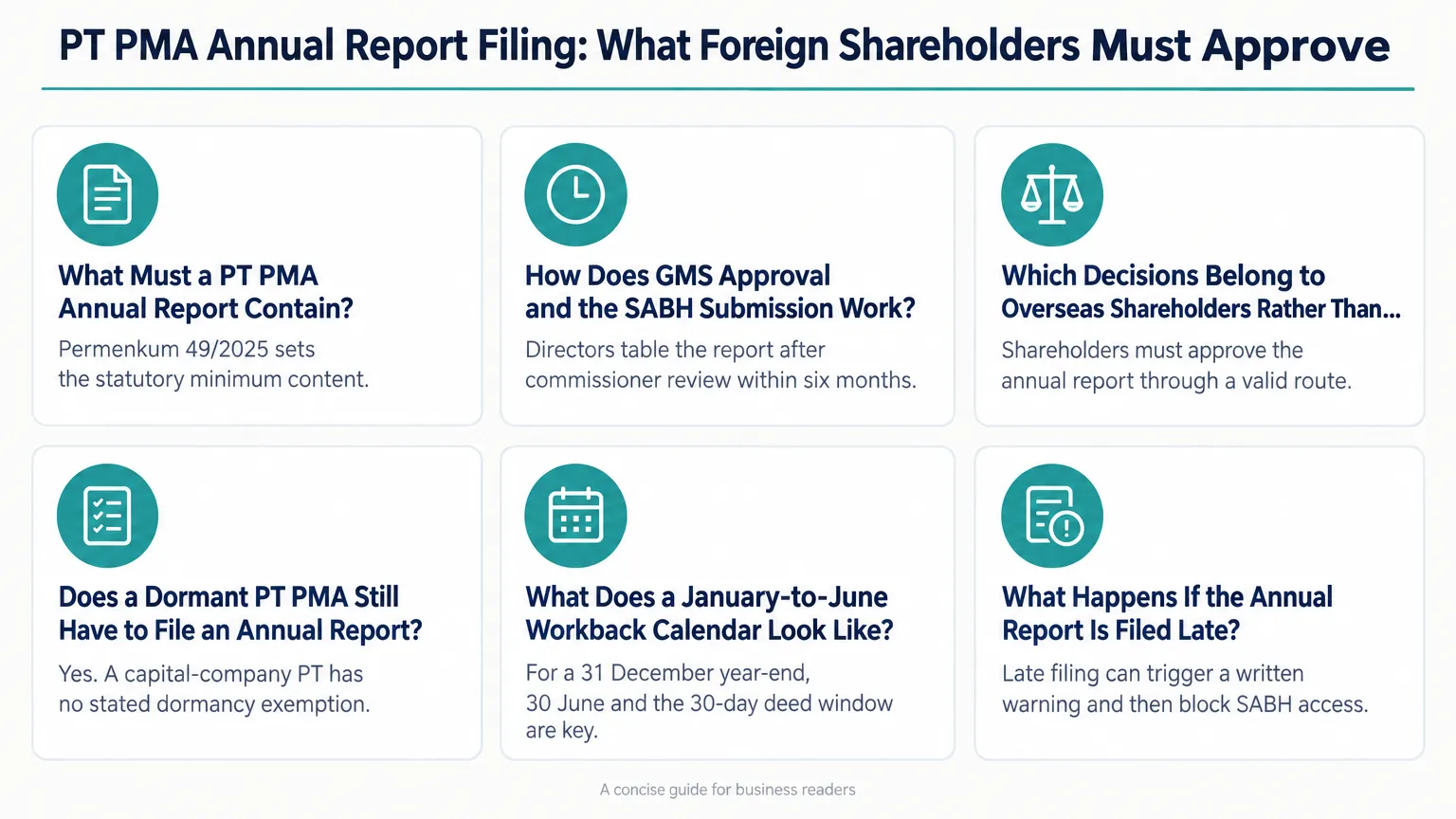
How Does GMS Approval and the SABH Submission Work?
Directors table the report after commissioner review within six months of the financial year-end. The deed is submitted through SABH within 30 days after signature.
Permenkum 49/2025 fixes the submission sequence. SABH is the Ministry of Law's electronic legal-administration system.
- Directors prepare the annual report, including the financial statements.
- The board of commissioners reviews the report.
- Directors submit the report to the GMS within six months after year-end.
For a 31 December year-end, 30 June is the latest permitted date. Calculate any other deadline from the actual financial year-end.
- GMS approval is recorded in a notarial deed.
- Directors submit the deed and annual report electronically through a notary using SABH.
The 30-day period starts when the notarial deed is signed. It does not start on the GMS date.
Article 16(5) names two mandatory supporting uploads:
- the notarial deed recording annual-report approval
- the annual report
Confirm live-system fields and requirements with the handling notary before filing. Article 16(7) provides for a receipt of notification from the Director General. Do not assume a processing time.
Key Steps and Deadlines in the Annual Report Process
| Step | Rule | Timing |
|---|---|---|
| GMS submission by directors | After commissioners' review | Within 6 months of the financial year-end |
| GMS approval | Recorded in a notarial deed | At the meeting, or by circular resolution |
| SABH filing via the notary | Deed plus annual report uploaded | Within 30 days of the deed date |
| Receipt of notification | Issued by the Minister through the Director General | After SABH receives the submission |
Shareholders must approve the annual report through a valid route. Management signatures cannot stand in for that approval.
Overseas shareholders should choose the approval route early. A properly convened GMS follows the Company Law and the company's articles. An electronic GMS may be suitable where the applicable rules permit it.
A written circular resolution is generally understood to rely on Article 91 of Law No. 40 of 2007. Under that interpretation, every voting shareholder must agree and sign. Confirm that reading against the current law and the articles before relying on it.
Before calling a meeting, confirm the approval route, quorum and voting thresholds with legal or notarial counsel. This is an interpretation, not a settled rule for every company.
Shareholder matters may include:
1. Approval of the annual report and ratification of the financial statements
The core decision. Without it, the directors cannot complete the notarial filing chain.
2. Use of profit or treatment of losses
Including any dividend distribution, which is a shareholder decision rather than a management one.
3. Appointment of an auditor where the articles reserve it to the GMS
Not every company appoints an auditor, but where the articles reserve the choice, only the shareholders can make it.
4. Discharge and release of directors and commissioners
To the extent disclosed in the report, the shareholders decide whether management is released from liability for the year.
Who Signs What in the Annual Report Pack
| Document | Prepared by | Signed or approved by |
|---|---|---|
| Financial statements | Finance team or Corporate Professional Advisors | Directors, who own their accuracy |
| Annual report | Directors | Directors and commissioners who served during the year |
| Commissioners' supervision report | Board of commissioners | Commissioners |
| GMS or circular approval | Company with the notary | Shareholders — all voting shareholders if circular |
| Notarial deed and SABH filing | Notary | Notary submits; the notary does not approve contents |
| Independent audit report, where required | Independent auditor | The auditor engaged for the audit |
Does a Dormant PT PMA Still Have to File an Annual Report?
Yes. A capital-company PT has no stated dormancy exemption under Permenkum 49/2025.
Dormant status changes the disclosures, not the filing sequence. Prepare each disclosure from the company's actual records.
A dormant activity section can explain that no revenue-generating operations occurred. It can identify limited compliance activities. Do not delete the social and environmental responsibility heading. State why it does not apply where appropriate.
The financial statements may still show cash, share capital, related-party funding and administrative expenses. Include notes where relevant. Commissioners should report on their review of dormant status and cash position.
Dormancy alone does not settle OSS, investment-reporting or tax obligations. Confirm each status with the relevant authority before assuming an obligation has ended.
Keep the corporate annual report separate from the annual corporate income tax return. DJP generally requires the return within four months after the tax year-end. A calendar-year return is generally due by 30 April. An extension of up to two months may be available through the prescribed procedure. Verify eligibility, payment requirements and the company's actual tax position.
Statutory audit is a separate entity-level assessment. The following Article 68 categories require confirmation against the current wording:
- companies managing public funds
- issuers of public debt
- public companies
- Persero companies
- companies with assets or turnover of at least IDR 50 billion
- entities required to audit under another law
Confirm the current Article 68 wording and the company's category. This is an interpretation, not an entity-level assessment.
1. Dormant PT PMA
Focus on evidence that supports nil trading. Review bank coverage, recurring expenses, shareholder funding and current legal registers.
2. Service company with outsourced bookkeeping
Focus on revenue cut-off and tax positions. Review contracts, invoices, withholding-tax slips, VAT, payroll and reimbursable expenses. Outsourced bookkeeping does not remove directors' responsibility for the figures.
3. Active trading company
Focus on inventory, imports and foreign-currency balances. Review stock counts, valuation, cut-off, customs documents and warehouse reconciliations. Add transfer-pricing support where the company's activities require it.
Evidence Focus by Company Type
| Company type | Evidence focus | Typical documents |
|---|---|---|
| Dormant PT PMA | Proving nil trading and residual balances | Bank statements, expense invoices, deeds, shareholder and beneficial-ownership records |
| Service company | Revenue cut-off and tax positions | Contracts, invoices, withholding-tax slips, payroll records |
| Trading company | Inventory, imports and currency | Stock counts, customs documents, warehouse reconciliations, foreign-currency balances |
What Does a January-to-June Workback Calendar Look Like?
For a 31 December year-end, 30 June and the 30-day deed window are key Article 16 deadlines; the Company Law also sets timing requirements for calling the GMS and making its materials available.
Article 16 fixes the GMS-approval and SABH-submission deadlines; the Company Law also sets mandatory requirements for GMS notice and availability of the annual-report materials.
Use the table as an illustrative planning calendar. Audit status, shareholder locations and notary availability can change intermediate dates.
The team's practical approach is to choose the approval route early. Maintain a single signer matrix. Pre-clear foreign authority documents before signatures are collected. These steps can reduce avoidable approval delays.
Foreign powers of attorney need early review. Pre-clear each foreign authority document with the notary in Indonesia. Requirements depend on the document, issuing jurisdiction and notary instructions. Notarisation, apostille, consular legalisation or sworn Indonesian translation may be needed. None applies universally.
Illustrative Workback Calendar for a 31 December Year-End
| Period | Milestone | Owner |
|---|---|---|
| January | Close the ledger and reconcile the trial balance | Finance team |
| February to March | Draft the activity narrative, commissioners' report and notes | Directors and commissioners |
| March to May | Audit fieldwork, where required | Independent auditor |
| May | Convene the GMS or circulate the resolution; sign the notarial deed | Shareholders and notary |
| Within 30 days of the deed | Submit the deed and annual report through SABH | Notary on behalf of the directors |
| By 30 June | Outside date for GMS approval | Directors |
What Happens If the Annual Report Is Filed Late?
Late filing can trigger a written warning and then block SABH access.
Articles 17 to 20 of Permenkum 49/2025 set the regulatory consequences. A company that fails to comply may be subject to a written warning. If the obligation remains unmet for 30 days after the SABH warning notification, SABH access can be blocked.
Unblocking requires an electronic application. It must include the Article 16(5) supporting documents.
These consequences arise from the regulation. They do not prove an outcome for any particular company. The risk is why the 30-day deed window needs careful management.
Directors and commissioners who served during the year must sign the report; if someone does not sign, the reason must be stated in writing by that person or by the directors in a separate letter attached to the report, and a person who gives no written reason is deemed to have approved it.
Conclusion
Three rules anchor the process:
- the report meets the Article 16(6) minimum
- the GMS approves it within six months after year-end
- the notarial deed is submitted through SABH within 30 days after signing
Dormancy affects report content, not the obligation. Overseas shareholders need a valid approval route. Confirm a GMS or circular-resolution route with legal or notarial counsel.
The team helps clients plan the workback, prepare report sections, coordinate commissioner review and manage cross-border signature collection. It aligns evidence with the company's actual activities rather than a generic checklist.
Contact 3E Accounting Indonesia at https://www.3ecpa.co.id/contact-us/ to put your company's annual report on a managed calendar.
Put Your Annual Report on a Managed Calendar
Speak with 3E Accounting Indonesia about GMS approval, notarial filing and SABH submission for your foreign-owned company: https://www.3ecpa.co.id/contact-us/
Frequently Asked Questions
Within six months of the financial year-end — 30 June for a 31 December year-end. The notary then files the approval deed and the annual report through SABH within 30 days of the deed date.
No. Directors and commissioners sign the report itself, but approval of the report and ratification of the financial statements must come from the shareholders, through a properly convened GMS or a circular resolution signed by every voting shareholder.
No. The regulation contains no dormancy exemption. A dormant company still prepares a report, obtains GMS approval and files through SABH, and must separately confirm its tax, investment-reporting and licensing status with the relevant authorities.
The notarial deed recording GMS approval of the annual report, and the annual report itself, under Article 16(5) of Permenkum 49/2025. Any additional live system requirements should be confirmed with the handling notary.
The company receives a written warning. If the obligation is still unmet within 30 days of the SABH warning notification, SABH access can be blocked, and unblocking requires an electronic application with the supporting documents.

Abigail Yu
Director
Abigail Yu oversees executive leadership at 3E Accounting Group, leading operations, IT solutions, public relations, and digital marketing to drive business success. She holds an honors degree in Communication and New Media from the National University of Singapore and is highly skilled in crisis management, financial communication, and corporate communications.