

One overseas invoice can trigger two separate Indonesian taxes and one treaty document — and the invoice itself never says which applies.
In this article, we discuss how an Indonesia PPh 26 foreign vendor payment is classified. We also explain when withholding tax and VAT apply. It covers Form DGT, PMSE rules and Coretax deadlines for SaaS, consulting and group charges.
How Does an Indonesia PPh 26 Foreign Vendor Payment Get Classified?
Before any tax is calculated, the payment must be classified by its legal and commercial substance — the label on the invoice is not determinative.
The same word "software" can describe a royalty-bearing licence, a hosted subscription or a simple goods purchase. Each can lead to a different tax result. The framework below reflects professional judgement on the questions an experienced reviewer resolves first. It is presented as a general decision framework, not as any single firm's documented procedure.
Tax matters that require escalation include possible royalties or embedded IP rights. They also include treaty technical-service provisions, Indonesian workdays or permanent-establishment indicators, related-party charges, and missing or contradictory treaty evidence.
1. What is actually being supplied
Whether the payment buys a service, a royalty, rent, interest, a reimbursement, goods or a related-party charge must be established first. The reviewer also asks whether any right to exploit copyright, know-how, trademarks or data passes to the Indonesian company.
2. Where the supply is performed or used
The place of performance or utilisation drives the imported-service VAT analysis and can affect the income-tax result under some treaties. A consultant's Indonesian workdays, fixed-place access and authority to conclude contracts can materially change the permanent-establishment analysis.
3. Who earns the income and where they reside
The legal recipient, its country of residence and — where the treaty requires it — whether that recipient is the beneficial owner of the income must all be established. Confirming the counterparty's legal identity through a company registry search in Indonesia is a practical starting point.
4. Whether a treaty rate is being claimed
If a reduced rate is expected, the treaty article, the recipient's residence, anti-abuse conditions and the supporting documents must line up at the moment the income becomes payable. Missing or contradictory treaty evidence at the tax point is a matter for escalation.
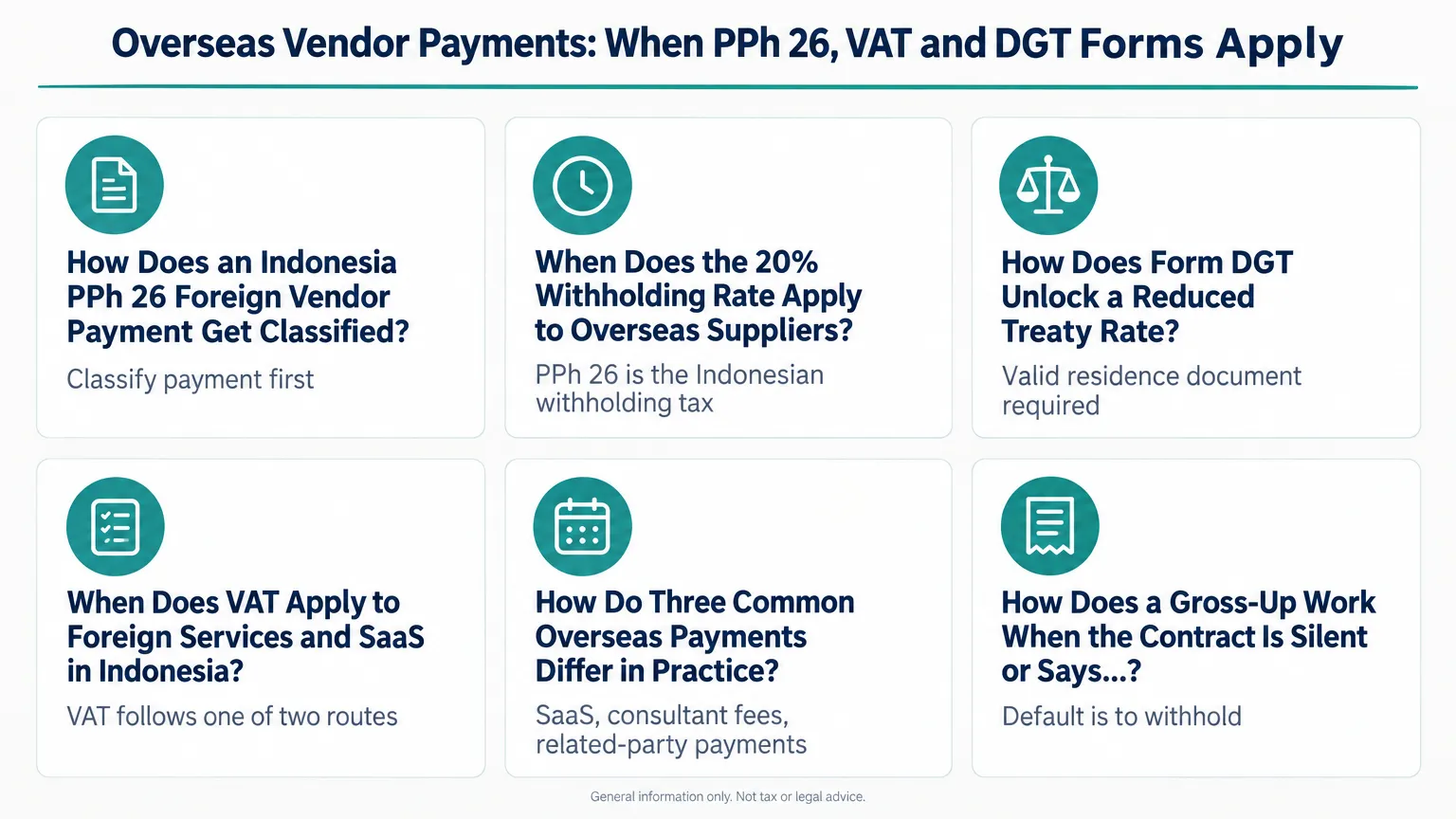
When Does the 20% Withholding Rate Apply to Overseas Suppliers?
PPh 26 (Pajak Penghasilan Pasal 26) is the Indonesian withholding tax on specified payments to non-residents, generally at 20% of the gross amount unless a tax treaty changes the result.
Under Article 26 of the Indonesian Income Tax Law, specified payments to a foreign taxpayer other than an Indonesian permanent establishment attract domestic withholding. This is set out in published guidance of the Directorate General of Taxes (DGT). The categories include royalties, rent and other income from the use of property. They also include fees for technical, management, consultancy and other services performed in Indonesia.
The DGT guidance confirms that where treaty conditions are not met, the 20% domestic rate applies to an Indonesia PPh 26 foreign vendor payment that falls within Article 26. The precise income classification, place of performance, treaty article and recipient status must still be tested for the particular payment. Another domestic rule can sometimes apply instead.
A payment invoiced through a foreign company's Indonesian permanent establishment is a different matter. It is typically handled under domestic withholding rules for the permanent establishment rather than PPh 26. This is one reason the permanent-establishment question is answered before coding.
How Does Form DGT Unlock a Reduced Treaty Rate?
A treaty rate only applies if a valid residence document is in hand when the income becomes payable. That document is Form DGT or a qualifying foreign certificate of residence under PMK 112/2025.
The Ministry of Finance procedure in PMK 112/2025 governs treaty-benefit claims. Form DGT must be completed and signed by the foreign income recipient, with residence certified by the foreign competent authority or supported by an acceptable certificate of residence. For Form DGT, the stated validity period may not exceed 12 months; a qualifying foreign certificate of residence is valid for its stated period, or for the tax period of issue if no period is stated.
In practice, verify that the legal name, address and tax identification number match the contract, invoice and bank details. Check the certified residence period separately. Test validity against the tax point, rather than the contract date. Requesting the document as part of vendor onboarding avoids most last-minute surprises.
If the pack is late, incomplete or expired when payment falls due, the operational fallback for an otherwise taxable payment is the domestic 20% rate. An unsupported treaty rate is not an option. A later document does not simply reverse the tax through the next invoice; corrections must follow the applicable overpayment or refund procedure. Whether a particular vendor qualifies for relief depends on the specific treaty, document period, anti-abuse conditions and recipient facts.
Typical Tax Treatment by Payment Type
| Payment type | Typical income-tax treatment | Usual VAT route |
|---|---|---|
| Hosted SaaS access | Tested as service or business profits; royalty if IP rights transfer | PMSE collection or self-accounted VAT |
| Software licence with reproduction or distribution rights | Often royalty under Indonesian law and many treaties | Self-accounted VAT on utilisation |
| Consulting or management fee | PPh 26 at 20% unless treaty or PE analysis changes the result | Self-accounted VAT if performed or used in Indonesia |
| Royalty (trademark, patent, know-how) | PPh 26 at 20%; treaty royalty article may reduce the rate | VAT on utilisation of intangibles |
| Interest, dividends, rent | PPh 26 at 20% unless a treaty reduces the rate | Generally outside the VAT net |
| Purchase of goods with no Indonesian services | No PPh 26 on the goods element | Import VAT at customs instead |
When Does VAT Apply to Foreign Services and SaaS in Indonesia?
VAT on foreign digital supplies follows one of two routes. A DJP-appointed PMSE collector charges the tax on its invoice, or the Indonesian customer self-accounts for VAT on imported services or intangibles.
Under the PMSE regime (Perdagangan Melalui Sistem Elektronik), the DJP appoints foreign suppliers of digital goods and services as VAT collectors. An appointed collector must charge Indonesian VAT on covered supplies. It must also provide collection evidence such as an invoice, billing statement or receipt. The collector must appear on the DJP's published list, as described on the DJP's PMSE VAT page.
Where the supplier has not been appointed, the Indonesian user may need to self-collect VAT. This depends on taxable utilisation in Indonesia. Under Article 3A(3) of the VAT Law, the user remits and reports that VAT. The rule covers intangible taxable goods or taxable services from outside the customs territory. Check the supplier's exact legal entity and appointment status at the transaction date — a brand name alone is not sufficient.
1. The PMSE collector route
The supplier charges Indonesian VAT on its own invoice, so the customer does not self-account for the same VAT. Keep the collection evidence, because it may support an input VAT credit for a company registered as a taxable entrepreneur (PKP).
2. The self-accounting route
Where no designated collector applies, the Indonesian recipient calculates the VAT, pays it to the state and reports it in its own VAT return. This route applies only where there is taxable utilisation in Indonesia.
3. The current VAT calculation
Under PMK 131/2024, most ordinary non-luxury supplies use a deemed tax base of 11/12 of the consideration, so the 12% statutory rate produces an effective 11% burden for 2026. Luxury taxable goods use the full tax base, while supplies subject to separately prescribed deemed tax bases or fixed-amount schemes follow their own rules. Confirm special bases, exemptions and the law in force at the tax point.
How Do Three Common Overseas Payments Differ in Practice?
Hosted SaaS subscriptions, foreign consultant fees and related-party management charges start from the same invoice but diverge quickly.
The scenarios below are expressly hypothetical illustrations of typical decision paths. They are not records of specific client matters, and the tax outcome in each case depends on the contract, the treaty and the facts.
1. Hypothetical hosted SaaS subscription
The first questions concern the order form and the access terms. Hosted, non-exclusive access without any right to reproduce, modify, distribute or commercially exploit the software may support a business-profits analysis rather than a royalty. That is a conditional point that must be tested against the relevant treaty. If the supplier is an appointed PMSE collector, it charges VAT on its invoice and the customer does not self-account.
2. Hypothetical foreign consultant fee
A statement of work showing advisory visits to Indonesia raises permanent-establishment questions. These include travel days, fixed-place access, authority to conclude contracts and the treaty's service-PE provisions. Even where no PE is triggered, an expired residence certificate at the tax point means the domestic 20% rate applies. A consultant who is not a PMSE collector leaves the Indonesian company to self-account for imported-service VAT.
3. Hypothetical related-party management charge
A group service charge needs more than an invoice and residency documents. A prudent documentation checklist includes an intercompany agreement, evidence that services were rendered and benefits received, an allocation basis and transfer-pricing consistency. This is a checklist of prudent practice, not a statement of deductibility.
Three Hypothetical Overseas Payments Compared
| Item | Hosted SaaS | Foreign consultant | Related-party charge |
|---|---|---|---|
| First classification question | IP rights in the access terms | Indonesian workdays and PE indicators | Substance, benefit and allocation |
| Main PPh 26 risk | Royalty versus business profits | Service-PE analysis and document validity | Treaty relief plus arm's-length support |
| VAT route | PMSE collector if appointed | Self-accounted by the customer | Self-accounted by the customer |
| Extra documents | Order form, access terms, Form DGT | Statement of work, travel record, Form DGT | Intercompany agreement, allocation key, transfer-pricing file |
How Does a Gross-Up Work When the Contract Is Silent or Says Net?
If the contract is silent, the default position is to withhold from the stated gross fee; if it promises the vendor a net amount, a gross-up applies.
Using expressly hypothetical figures: a contract requires a consultant to receive a net IDR 100 million, with domestic PPh 26 at 20%. The grossed-up fee is IDR 100 million divided by 0.8, or IDR 125 million. Withholding is then IDR 25 million, leaving the vendor IDR 100 million.
If the contract is silent, an invoice of IDR 100 million means IDR 80 million paid out and IDR 20 million remitted as tax. Confirm that "net" genuinely means net of Indonesian withholding before applying either approach.
Where self-accounted VAT also applies at the ordinary effective 11% treatment, VAT on the IDR 125 million consideration is IDR 13.75 million. That amount is payable to the state, not deducted from the vendor's net receipt. It may be creditable as input VAT for a taxable entrepreneur with complete evidence. With a 10% treaty rate instead, the gross-up would be about IDR 111.11 million, with withholding of about IDR 11.11 million.
Renegotiation is advisable once a contract uses vague "all taxes included" wording, mixes withholding and VAT, or obliges the Indonesian party to absorb any future recharacterisation. Better drafting states the fee exclusive of VAT, permits legally required withholding and addresses any agreed gross-up expressly. The applicable rate, contract wording, VAT treatment and deductibility must be confirmed before relying on any of these figures.
What Are the Payment and Filing Deadlines After Withholding?
PPh 26 must be remitted by the 10th of the following month and reported by the 20th; self-accounted imported-service VAT is due by the 15th.
After the withholding event, the company creates the withholding slip through DJP's e-Bupot Unifikasi process in Coretax. It records the foreign payee and the treaty or domestic treatment, and generates the billing instruction. The tax is remitted by the 10th of the following month, and the periodic unified income tax return is filed by the 20th.
Self-accounted VAT on foreign services or intangibles is paid by the 15th of the following month. The tax point determines the relevant month. It is reported in the monthly VAT return for the period in which it fell due. A late monthly VAT return currently attracts a fixed administrative penalty of IDR 500,000. Confirm current deadlines with the DGT for the specific transaction.
All filings presuppose an active tax identification number (NPWP) and Coretax access, which newly incorporated companies receive in sequence after incorporation. At month end, reconcile withholding slips, the withholding-tax control account and bank payments. Do this transaction by transaction, rather than only by totals. This catches the most common break: an invoice paid net while the ledger still carries the full vendor payable. No separate withholding liability is recorded. That creates an apparent duplicate balance.
Key Deadlines for Overseas Vendor Payments in 2026
| Obligation | Deadline |
|---|---|
| PPh 26 remittance | 10th of the following month |
| Unified monthly withholding return | 20th of the following month |
| Self-accounted imported-service VAT payment | 15th of the month after the VAT tax point |
| Reporting of self-accounted VAT | Monthly VAT return for the period the VAT fell due |
What Should a Pre-Payment Control Checklist Cover?
A suggested control pack ties the commercial, tax and banking evidence together before funds are released.
Described as a suggested checklist rather than any firm's documented workflow, a robust pre-payment pack links the following items:
- signed contract or order form, and the invoice
- service description with acceptance or utilisation evidence
- vendor legal identity, tax residence and bank beneficiary details
- Form DGT or certificate of residence, valid at the tax point
- PMSE-list search result and VAT evidence
- treaty article and rate, or the documented domestic fallback
- gross-up treatment and the tax point
- GL coding and the post-payment reconciliation reference
Payment should be blocked where the invoice description conflicts with the contract. It should also be blocked where the bank beneficiary differs from the income recipient without explanation. Treaty relief lacking a valid document trail is another block trigger. Companies without an in-house tax function can have the pack assembled and reviewed through the contact page of an experienced provider.
Conclusion
Paying an overseas vendor safely comes down to sequence. Classify the payment first, test the treaty position and documents, settle the VAT route, and only then release funds and file by the statutory deadlines.
The recurring trouble spots are familiar. A residence certificate expires before the tax point. A SaaS invoice is assumed to be automatically tax-free. A group charge is cleared on paperwork that cannot support a deduction. Each is avoidable with the right checks before payment.
3E Accounting Indonesia is a Corporate Services Provider that supports local and foreign-owned companies with withholding tax compliance. The team also assists with VAT registration and filing through Coretax, and with cross-border payment reviews. Talk to the team to put a reliable process around your next overseas vendor payment.
Put Your Overseas Payments on a Compliant Footing
3E Accounting Indonesia can review your vendor contracts, treaty documents and VAT position before the next payment leaves the bank.
Frequently Asked Questions
No. The domestic rate is 20% of the gross amount for specified payments under Article 26, but a tax treaty can reduce it, and classification, permanent-establishment status and recipient facts must be tested. Without a valid treaty document at the tax point, the 20% rate applies.
It depends on the contract terms. Hosted, non-exclusive access without rights to reproduce, modify, distribute or commercially exploit the software may follow a different treaty analysis from a licence granting royalty-like rights. Review the order form and access terms before coding the payment.
The domestic 20% rate applies at the tax point. A replacement document obtained later does not automatically reverse the withholding, and any correction must follow the applicable overpayment or refund procedure rather than netting against the next invoice.
No. An appointed PMSE collector charges Indonesian VAT on its own invoice, so the customer does not self-account for the same VAT. Verify the supplier's exact legal entity on the DJP's published collector list at the transaction date.
Not by offsetting it against the next payment. The foreign recipient generally pursues relief or a refund under the applicable Indonesian procedure or the relevant treaty, using the withholding slip issued by the Indonesian payer.

Abigail Yu
Director
Abigail Yu oversees executive leadership at 3E Accounting Group, leading operations, IT solutions, public relations, and digital marketing to drive business success. She holds an honors degree in Communication and New Media from the National University of Singapore and is highly skilled in crisis management, financial communication, and corporate communications.