


Law No. 7 of 1981 states sanctions of up to three months' confinement or a fine of up to IDR 1,000,000 for failure to make the required initial, annual, or pre-event reports. It also sets a 30-day deadline after a company is established, restarted, or moved.
In this guide, we explain the WLKP Indonesia first report process for a new company. We also cover record updates when it hires its first employee or moves address, including statutory deadlines, SIAPkerja, BPJS registration, and PKWT recording.
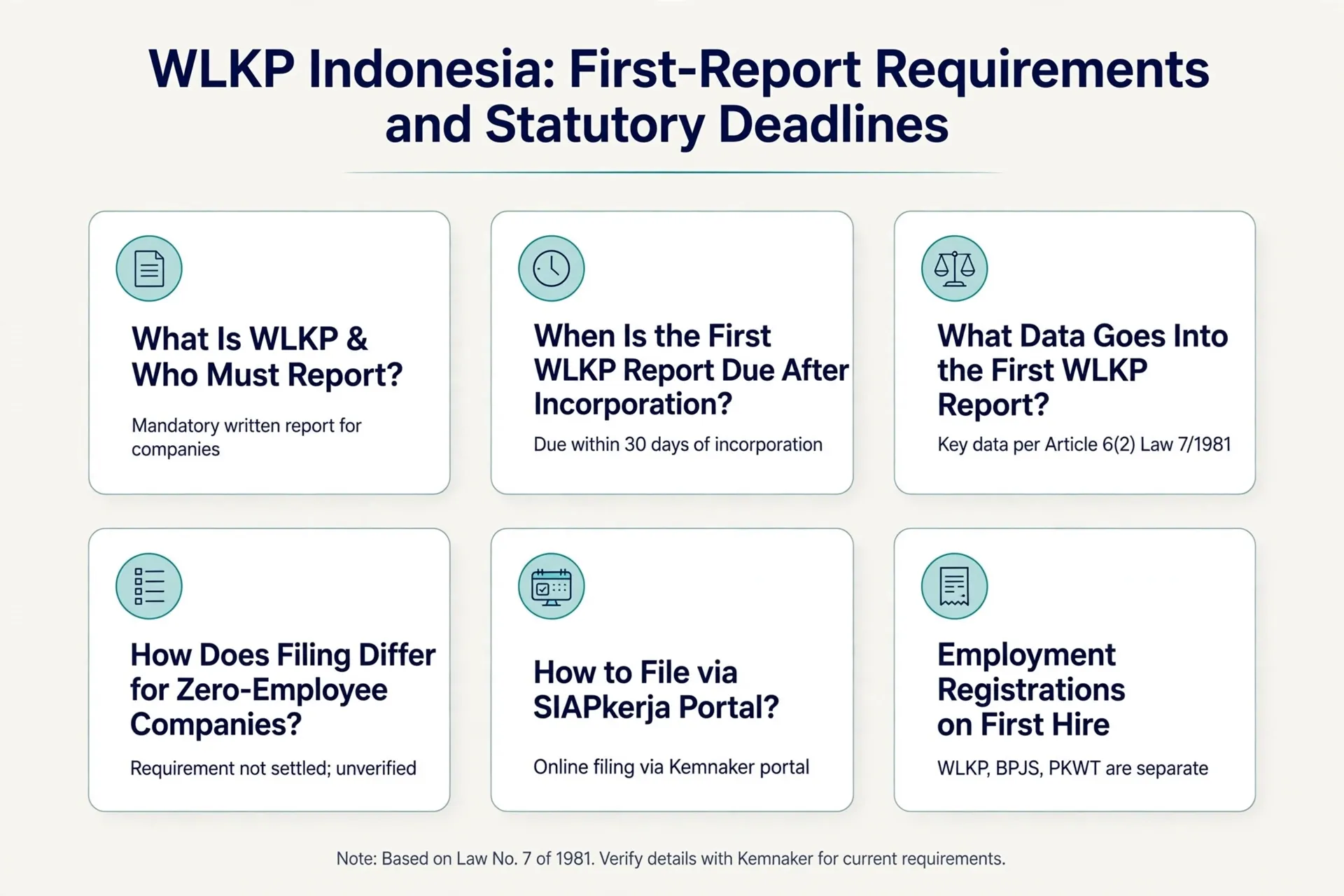
What Is WLKP and Which Companies in Indonesia Must Report?
WLKP (Wajib Lapor Ketenagakerjaan) is the mandatory written company report on employment matters that employers and company managers must file with the manpower authorities under Law No. 7 of 1981.
Article 4 of the law requires written reporting when a company is established, stops operating, restarts, moves, or is dissolved. The report must be made to the Minister or an appointed official; Kemnaker provides the online WLKP system.
The statute defines a company by reference to an undertaking that employs workers. Because of that definition, whether an incorporated entity with no workers is already within scope is not answered explicitly by the statute. The prudent step is to confirm the position with the local manpower office or Indonesian labour counsel before assuming an exemption.
For an incorporated entity with no workers, the statutory position should not be stated categorically. Obtain a dated opinion from labour counsel in Indonesia and a current production-portal test before deciding whether or how to file.
When Is the First WLKP Report Due After Incorporation?
The first report is due no later than 30 days after the company is established, restarted, or moved, under Article 6(1) of Law No. 7 of 1981.
Getting the first WLKP timing right starts with the statutory definition of establishing a company. The law defines it as commencing physical company activities and/or obtaining a licence, so the 30-day period does not automatically begin on the incorporation date in the deed.
As a practical interpretation, identify the actual activity-start and licensing dates, and obtain labour advice in Indonesia if they differ. Do not assume that incorporation or a first hire alone determines the statutory trigger.
After the initial report, Article 7(1) requires an annual recurring report. The online reporting procedure is governed by Permenaker No. 18 of 2017, as amended; confirm the current annual filing month in SIAPkerja rather than assuming a December deadline.
Article 8 adds a pre-event rule. Before moving, stopping, or dissolving a company, the employer must report at least 30 days before the event. Article 6 separately provides for a report within 30 days after a move, so obtain advice on how both provisions are applied in the current online workflow.
Finally, Article 10 states the consequence of non-compliance in statutory terms: a violation carrying up to three months' confinement or a fine of up to IDR 1,000,000. This is the text of the law, not a prediction of how enforcement is applied in any particular case.
WLKP Reporting Events and Statutory Deadlines
| Reporting Event | Deadline | Legal Basis |
|---|---|---|
| Company established, restarted, or moved | Within 30 days after the event | Article 6(1), Law No. 7 of 1981 |
| Initial report contents | Company identity, employment relations, worker protection, employment opportunities | Article 6(2), Law No. 7 of 1981 |
| Recurring report after the initial filing | Annual | Article 7(1), Law No. 7 of 1981 |
| Planned move, cessation, or dissolution | At least 30 days before the event | Article 8, Law No. 7 of 1981 |
| Failure to report | Up to 3 months' confinement or a fine up to IDR 1,000,000 (statutory text) | Article 10, Law No. 7 of 1981 |
What Data Goes Into the First WLKP Report?
Article 6(2) of Law No. 7 of 1981 requires the initial report to cover four statutory areas: company identity, employment relations, worker protection, and employment opportunities.
The statute sets the four required categories, while the online portal determines the exact fields. The checklist below is a suggested first-filing preparation and reconciliation pack, based on professional judgement rather than a current SIAPkerja specification or mandatory document list. Confirm every field, supporting document, and upload requirement in the live portal before filing.
1. Corporate identity documents
Gather the latest deed of establishment and all amendments. Also collect the Ministry of Law approval or receipt, current Nomor Induk Berusaha (NIB) from OSS-RBA, company Nomor Pokok Wajib Pajak (NPWP), and KBLI (Klasifikasi Baku Lapangan Usaha Indonesia) codes shown on the NIB. The deed is the source for legal name and management. The NIB is the source for operating address and business codes.
2. Address and domicile evidence
Keep evidence of the actual operating address, such as a lease or building details, plus any domicile letter that was issued. If the live form asks for the administrative-area hierarchy, reconcile the province, regency or city, district, village, and postcode to the address records before filing.
3. Company and contact details
Prepare the establishment and operational-start dates, head-office or branch status, ownership structure, business description, and a company-controlled email address and mobile number that can receive verification codes.
4. Responsible person details
Provide the director or person in charge, and the identity card (KTP) or NIK details of the portal user, where the portal requests them.
5. Workforce data
Set a workforce cut-off date, then record worker totals for Indonesia nationals and foreign nationals, sex and employment-status breakdowns, and working-time arrangements based on the dated employee master.
6. Wage, BPJS, and industrial-relations data
Where the live form requests them, prepare:
- Minimum and maximum wages
- BPJS registration details
- Union or company-regulation information
- Collective agreement data
- Vacancies and training activity
- Disability-worker data
- The responsible officer's declaration
WLKP Field Sources and Reconciliation Reference
| WLKP Data Field | Primary Source Record |
|---|---|
| Legal name and legal form | Latest deed of establishment and Ministry of Law record |
| Business status and KBLI codes | Current NIB from OSS-RBA |
| Tax identification (NPWP) | Company NPWP registration record |
| Operating address and area hierarchy | NIB, lease, and the actual workplace |
| Worker totals and classifications | Dated employee master and payroll records |
| BPJS employer and participant numbers | BPJS certificates or portal records |
How Does Filing Differ for a Company with No Employees?
The zero-employee treatment is not settled by the statute or verified live-portal guidance. Obtain dated advice before deciding whether or how to file.
Entering zero workforce totals is an unverified practical interpretation, not an explicit statutory rule. The statute defines a company by reference to employing workers. No published portal rule supplied for this article settles the zero-worker position. Confirm the current treatment with the manpower office or labour counsel in Indonesia before filing.
Two pitfalls are worth avoiding. First, never create a dummy worker to satisfy a field. Second, a director or commissioner who appears in the deed is not automatically a payroll employee. Check the actual employment and payroll arrangement before counting any officeholder as a worker.
When a company begins employing its first payroll hire, review WLKP totals, BPJS registration, and any PKWT recording as distinct processes. If a WLKP report is made, use the actual employment start date and contract classification. Reconcile worker totals against the employee master and payroll.
How Do You Complete WLKP Through the SIAPkerja Portal?
WLKP is filed online through the SIAPkerja portal operated by Kemnaker, under Minister of Manpower Regulation No. 18 of 2017, as amended.
Permenaker No. 18 of 2017, as amended, governs online WLKP procedures. Permenaker No. 17 of 2024 regulates SIAPkerja as a national employment-information ecosystem.
Live-portal field and workflow guidance was not verified for this article as of 1 October 2026. Confirm the current screens, required fields, and recovery route in the production portal before filing.
We recommend a governance control for account ownership that is advisory, not a government requirement. Use a company-controlled email address and mobile number, hold a director accountable for the account, and let HR, compliance staff, a secretary and an administrative assistant operate it day to day. When assigning that operational role, name a documented account operator and a separate account owner, because portal access, notifications, and OTP codes follow whoever holds the credentials.
Step 1: Build the source pack before opening the portal
Assemble the deed, NIB, NPWP, KBLI codes, address evidence, and contact details first. Flag any discrepancy between the deed and the NIB before filing, rather than choosing whichever version is convenient.
Step 2: Register and secure the account
Register the company using contacts the company controls, so the account survives staff turnover. Record who is accountable and who operates the account.
Step 3: Complete and validate the report
Enter the data consistently across every section. Do not treat portal acceptance as confirmation that a field is complete or reconciled.
Step 4: Distinguish acceptance from accuracy
A submission the portal accepts is not evidence the data is correct. Reconcile every field against the source records and retain the filing confirmation and supporting documents for later manpower processing.
What Employment Registrations Accompany the First Hire?
WLKP, BPJS registration, and PKWT recording are separate compliance actions — completing one does not complete the others.
BPJS Ketenagakerjaan's official guidance states that employers must register themselves and their workers, supplying worker and wage data. Check the worker category and the current applicable rules before assuming that BPJS Kesehatan and BPJS Ketenagakerjaan timing and documentary requirements are identical for every first hire across the time zones in Indonesia.
For fixed-term contracts, Government Regulation No. 35 of 2021 (PP 35/2021), Article 14, requires a PKWT (Perjanjian Kerja Waktu Tertentu, or fixed-term employment agreement) to be recorded online no later than three working days after signing. Where online recording is unavailable, the agreement must be recorded in writing with the relevant local manpower office within seven working days. This rule is limited to PKWT; not every employment contract is a PKWT.
These are distinct processes as a matter of law and administration. Whether any current system integration has changed the practical steps is worth confirming with the relevant authority at the time of filing.
Zero-Employee Company vs First Payroll Hire
| Item | Zero Employees | First Hire |
|---|---|---|
| Workforce totals | Confirm current zero-worker treatment before entering workforce totals | Actual joiner counts reconciled to payroll |
| BPJS registration | Not created merely to fill fields; confirm treatment | Employer and worker registered under applicable rules |
| PKWT recording | Not applicable until a fixed-term contract exists | Recorded within the statutory working-day limits |
| Supporting payroll data | None required | Employee master, wage basis, and effective dates |
WLKP, BPJS, and PKWT Obligations Compared
| Obligation | Administering Authority | Key Deadline |
|---|---|---|
| WLKP company report | Kemnaker under Law No. 7 of 1981 | 30 days after establishment, restart, or move |
| BPJS Ketenagakerjaan registration | BPJS Ketenagakerjaan | When the employer begins employing workers |
| PKWT recording | Ministry of Manpower online; relevant regency/municipal manpower office only where online recording is unavailable | Online: 3 working days after signing; written: 7 working days |
Which Events Trigger a WLKP Update Later On?
Statutory WLKP triggers include a move, stop, restart, and dissolution. First hires, KBLI changes, foreign-worker changes, and BPJS changes are practical review triggers, not statutory deadlines identified here.
The statute treats the move, the stop, the restart, and the dissolution as reporting events in their own right. A planned cessation or dissolution must be reported at least 30 days before the event, and a restart within 30 days after it.
Practical WLKP record-review triggers include:
- First hire, joiners, and leavers that change workforce totals
- Foreign-worker starts and ends
- Address moves, which are statutory reporting events
- Added or removed KBLI codes
- Suspension of activity, restart, merger, closure, or dissolution
- BPJS status changes
Conclusion
WLKP has its own statutory reporting timetable under Law No. 7 of 1981. The initial report follows the statutory establishment trigger, while Article 7(1) requires the recurring annual report after the initial filing. Permenaker No. 18 of 2017, as amended, governs the online reporting procedure; confirm the current annual filing month and workflow in SIAPkerja. Planned moves or cessations require advance reporting. BPJS registration and PKWT recording are separate processes with their own requirements.
For new companies, preparation means assembling source records and reconciling relevant data. Compare the deed, NIB, NPWP, and payroll records before filing. Confirm zero-employee treatment and current portal fields with the manpower office or labour counsel in Indonesia at the time of filing.
As a Corporate Services Provider, 3E Accounting Indonesia can assist with WLKP preparation and ongoing record reviews for hires, moves, and status changes. Contact us to discuss the scope of support.
Need Help With Your First WLKP Filing?
Our team handles WLKP registration, SIAPkerja filing, and employment compliance for new and expanding companies in Indonesia.
Frequently Asked Questions
The statute defines a company by reference to employing workers, so it does not expressly resolve the position for a zero-employee entity. Do not assume either that filing is required or that an exemption applies. Obtain dated advice from labour counsel in Indonesia and confirm the current production-portal treatment.
The first report is due within 30 days after the company is established, restarted, or moved. The law defines establishing as commencing physical activities and/or obtaining a licence, so the clock does not automatically start on the incorporation date. A planned move, cessation, or dissolution must be reported at least 30 days before the event.
Article 7(1) of Law No. 7 of 1981 requires an annual report after the initial filing. The online reporting procedure is governed by Permenaker No. 18 of 2017, as amended; confirm the current annual filing month and SIAPkerja workflow before submitting.
No. WLKP, BPJS registration, and PKWT recording are separate compliance processes governed by different rules. Employers must register themselves and workers with BPJS Ketenagakerjaan under applicable participation rules. A PKWT must be recorded online within three working days of signing, or in writing within seven working days where online recording is unavailable.
WLKP is filed online through the SIAPkerja portal operated by Kemnaker, under Minister of Manpower Regulation No. 18 of 2017, as amended. Confirm the current portal field list and any document-upload requirements before submitting.

Abigail Yu
Director
Abigail Yu oversees executive leadership at 3E Accounting Group, leading operations, IT solutions, public relations, and digital marketing to drive business success. She holds an honors degree in Communication and New Media from the National University of Singapore and is highly skilled in crisis management, financial communication, and corporate communications.